In the early afternoon hours of January 13, one of the most deadly single incidents during the Russian aggression in southern and eastern Ukraine hit a bus near a police / border guards checkpoint at the northern outskirts of the Ukrainian city of Volnovakha.
Shortly after the tragedy, a (graphic!) video appeared on YouTube, being widely assumed as the main evidence to find out, what happened to the bus and – the main question – who caused that massacre on innocent civilians. However, different versions of sense making appeared, seemingly contradicting each other. One of a Russian-fired missile or artillery round, hitting the area around the checkpoint and causing the carnage, published by pro-Ukrainian analysts; one of an Ukrainian mine, hitting the bus, leading to the senseless deaths; published by pro-Russian activists. Since then the two factions are confronting each other with their evidence, blaming the other side of lying. This short article argues that both are partly right and there is common ground between them, explaining the massacre.
Within a couple of hours, interpretermag published a report, convincingly illustrating that a rocket or artillery round, fired from the Russian-held Dokuchajevsk area to the north east, hit just right of the bus, causing the disaster (image below). Both the impact crater and the damage on the ground support this argument, which can not be refuted.
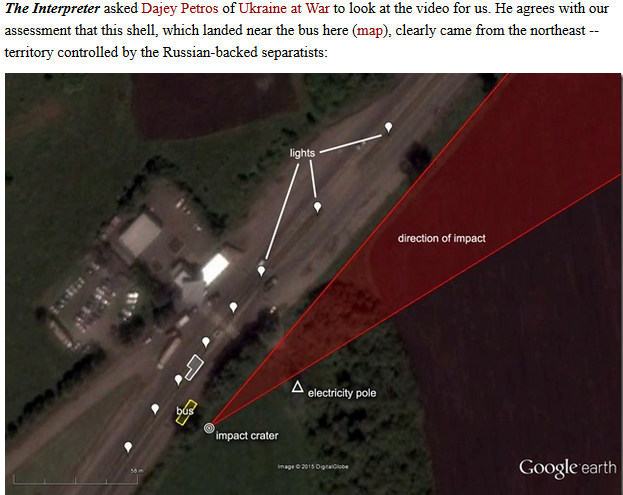
Source: The Interpreter, analysis by Dajey Petros
Shortly after, a pro-Russian side published a report based on the same video, pointing out that the bus was very close to an Ukrainian mine field, an Ukrainian soldier could be seen, carrying and anti-personal mine just outside the bus and typical fragments of an Ukrainian-used MON-50 mine could be seen between the blood of the victims inside the hit vehicle (images below). The three aspects, despite not supporting the official Ukrainian version of the events, must be taken into account, trying to understand what caused the bloodbath.

Source: http://zergulio.livejournal.com
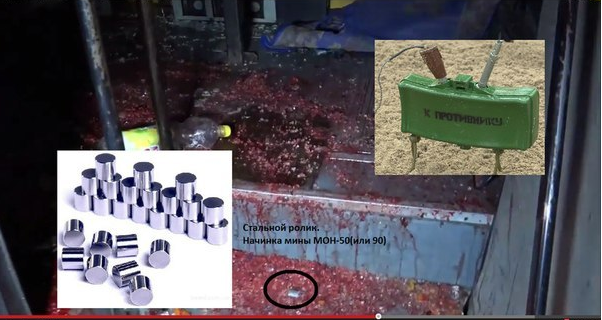
Source: http://zergulio.livejournal.com
Making sense of it all: From a fact-based analytical perspective, all surrounding circumstances must be considered, no matter of the political alignment. In this regard, both version are supported by facts and no obvious manipulation can be seen from my understanding. Hence the question arises, if both version are true and a combination of different fatal weapons – used by Russian invaders and placed by Ukrainian defenders – led to the deaths of 13 innocent people with several more still fighting for their lives in hospitals.
From all available data (video footage only, not statements by either side), it appears that the Russian-fired impacting shell hit the mine field to the right side of the bus, triggering a chain reaction by causing one or more of the there-put MON-50 to explode. Not in the intended direction – away from the street – but due to the impact power right towards the passing by bus, causing a catastrophe. Thus, BOTH, fragments of the Grad missile / artillery round AND of the thrown-up mines hit the bus in a totally uncontrolled manner, causing the visible damage, which could be seen in the aftermath footage. The subsequent analytical display portrays what could have happened within seconds yesterday afternoon, leading to imminent mass casualties. This conclusion seems most convincing as it includes all available evidence from the scene.
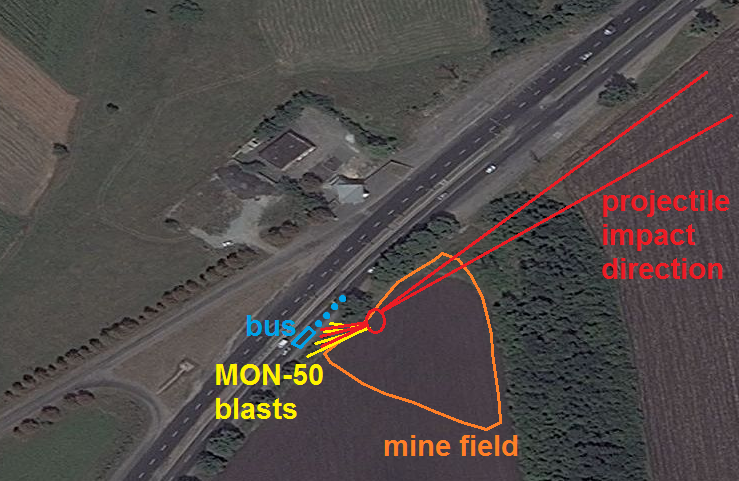
Source: own creation, based on Bing Maps
So who is to blame? The answer is obvious: The Russian side. They fired towards the checkpoint, knowingly that civilian vehicles would be queueing there, waiting to be checked before leaving / entering Volnovakha. By firing at the Ukrainian government checkpoint, they approved civilian casualties, once again showing their total disrespect for innocent human life and the “rules of war”.
At the same time, it must be concluded that the Ukrainian side unnecessarily tried to cover up that not only an incoming projectile, but mainly the accidentally triggered MON-50 mines (caused by the intentionally fired shell of course!) hit the chassis of the passing bus, causing 13 deaths. Ukrainian troops removed some of the mines – also simply to be safe during the rescue and recovery operation – and the Ukrainian government version doesn’t mention any mines involved in the tragedy. This behavior is – as I said – absolutely unnecessary and contraproductive as it produces doubt about the version where all moral arguments about the blame are on the Ukrainian side.
In conclusion, what we saw yesterday was another unprovoked act of violence vs. civilians by Russian terrorist and army forces, willing to advance at any cost. The Volnovakha bus massacre was caused by its deliberate actions vs. Ukrainian-held territory, leading to a deadly chain of reactions which killed 12 more Ukrainians in the Russian-led war.
Update #1
As many experts argue, I am wrong with my analysis, I took another look at the only known Grad impact location in the field and the location and external damage at the bus at this time. The missile impacted at least 10 meters from the bus, hitting deep into the snow with most of its energy. I see no chance, it caused the visible damage at the bus and plus 12 deaths inside it. There must have been secondary blasts, caused by triggered / hurled up mines, to cause such damage and casualty picture.

bus-impact distance
PS: In the end, I can not say, which kind of mines were placed in the field, MON-50 or – maybe more convincing – other sorts of contact mines. However what I can say is that the official version (one Grad missile hit) does not add up.
Update #2
Meanwhile, more footage appeared and I did some more analyzing of the already known material.
At first, I took another look at the impact site yesterday. If the Grad missile really hit the area from an N-NE angle – and nobody doubts that – its main force should have gone to the S-SW. The impact area confirms this and shows that most of the snow was burned in that direction, indicating that also most of the impact and explosive energy of the missile must have been directed towards this angle (picture below).

impact direction towards S-SW
At the same time, the bus is located 7-10 meters to the N-E of the impact crater and only little snow is burned in that direction before and after the little mound on the side of the street. So IF the buse was hit by the main force of the missile, which would have been necessary to cause such carnage, it should have been some more meters down the road to directly “drive into” the main blast direction. A look at its front shows that this is not the case.

undamaged bus front
Thus, it must be assumed that the bus stood exactly where it was filmed when it was hit, so to the right of the main blast energy of the impacting Grad. A last look at the bus illustrates that the damage is not the same all over, but different zones show a different degree of external damage (image below). The “what cause what” mark is just an estimate of course. The main point is that such damage is very unusual for being caused by a Grad that hit a snowy field, 7-10 meters in a 90° angle to its impact. It is almost unthinkable that 20+ people got killed and injured by the Grad blast. The tree shows also blast damage, which could well be from the exploding missile. However this tree is only 1-2 meters away from the impact site, while the buse is located further away. In conclusion: It remains hard to believe the missile alone caused 12 deaths inside the bus, despite exploding too far away and not being “directed” towards the affected bus.
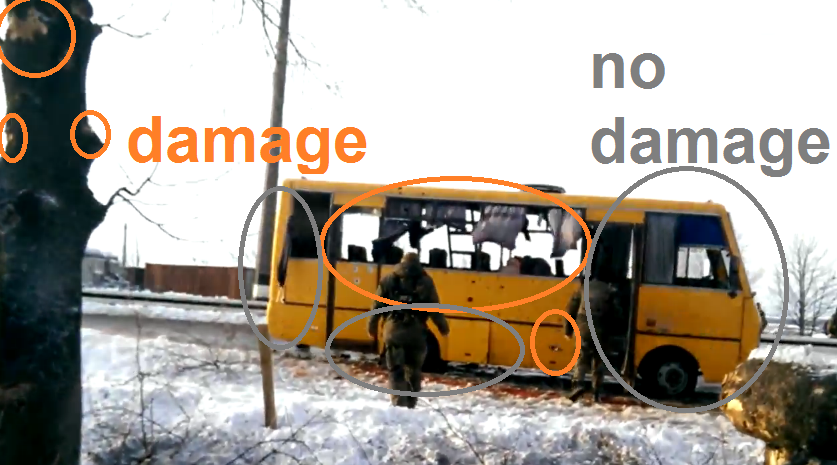
bus damage
Last but not least, a video appeared, showing the Grad attack on the checkpoint that caused the deaths. Althoug the camera is directed towards the north and only captures the shadow of he bus blast, it contains an interesting detail. The missiles that hit nearest to the base – also close to the street and near the trees – possibly caused the same as what I am pointing to on the other side of the base, namely a secondary blast by a mine, located close to where the missile hit. While all other missiles – also impacting in the middle of the street – caused dark shallow smoke, this one caused a bright flash up in the trees accompanied by upgoing white smoke in addition to the black one. Althoug the images are blurry and no final conlusions can be drawn, this could be the precedent that makes my interpretation of the events yet a bit more likely.
 Conflict Report