Today, the aggression versus the Ukrainian people reached a new peak when close to a hundred Grad missiles hit residential eastern neighborhoods of the port city of Mariupol, a hot spot of fighting since Russian army forces invaded the district of Novoazovsk in late August last year and advanced almost until the city limits of Mariupol. 27 Ukrainian civilians (including 2 children) and 1 soldier at a nearby checkpoint were killed plus another 97 civilians injured in what can be described as a deliberately caused massacre of the local civilian population.
But who caused that massacre? The answer is too obvious. Nonetheless, this article points out a 100% reliable blame, leaving no doubt who killed another 27 civilians after the Leninsky and Volnovakha bus attacks over the last days, killing 26 people and clearly bearing the hallmarks of the same criminal regime. At the same time it should be emphasized that it is not rocket science to determine who fired a missile, knowing some technical data of the weapons involved and having an elementary knowledge of the local geopolitical context.
Step 1: Geolocating footage, showing an impact crater
Minutes after the attack occurred, multiple videos appeared on the net, showing burning buildings and damage and some of them also direct impact locations and craters of the used missiles. In just another few minutes, these videos can be geolocated, using widely known open source maps.
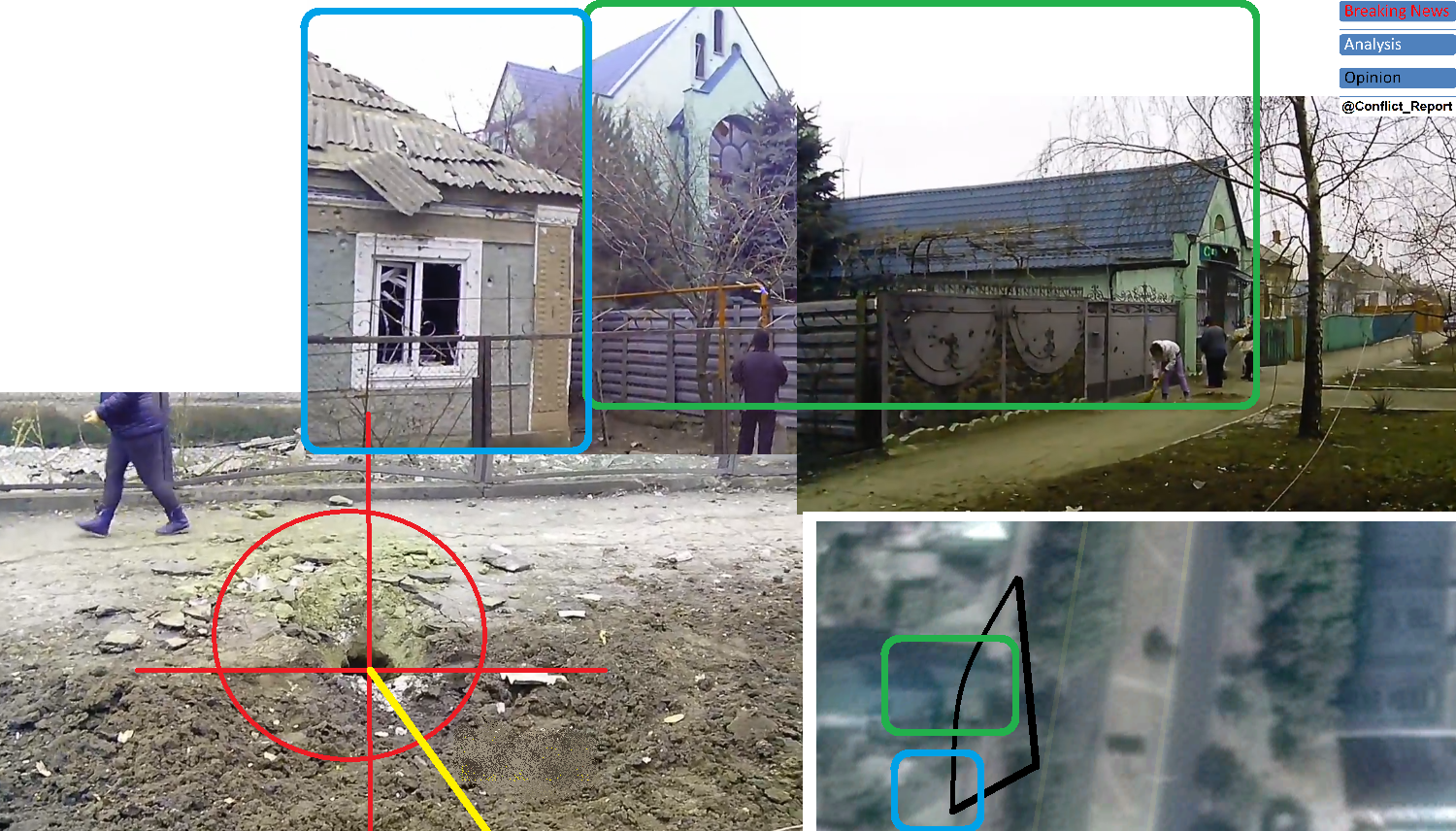
Geolocation of the impact
The above example shows how the footage can be affiliated with a an exact location and camera angle. A closer look at the impact gives clear indication of where the missile came from. This should be marked for further analysis.
Step 2: Determining the approach angle
Having done this, it is only a question of knowing how to use a compass to determine the direction of which the impacting projectile came from on a local scale. The camera angle as well as identified fixed objects in the footage / on the connected map give a precise impression of the approach angle of the missile that caused the damage and especially crater in the picture. It came from the east, slightly more than 90 degrees.
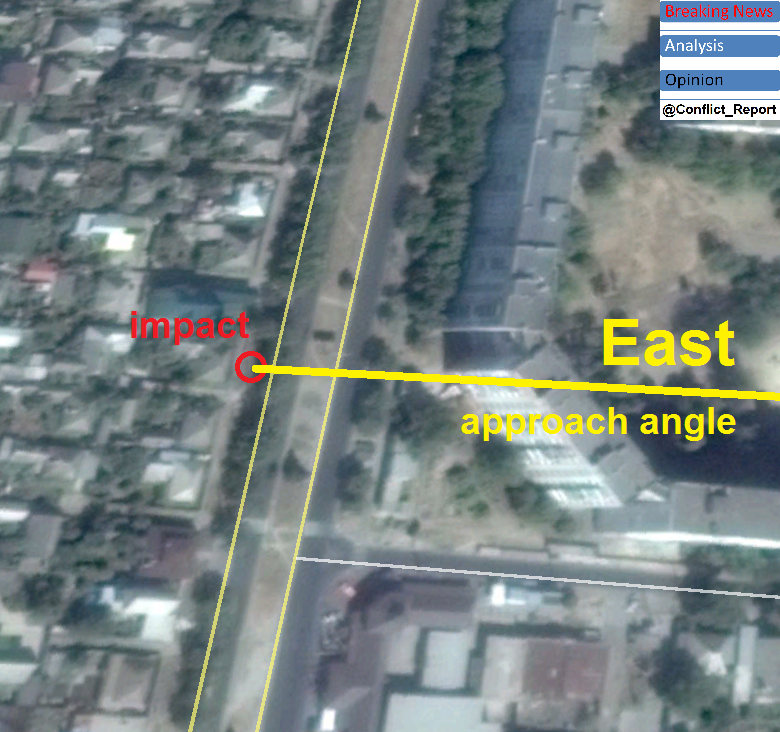
approach angle of the missile
Step 3: Providing technical and geopolitical context to the physical facts
The last step is to put the obtained data in context, meaning to lean back and ask what this means in a broader political – and in this case – spatial context. Hence the geopolitical circumstances – the “Who owns what?” – as well as the technical features of the weapon involved must be taken into consideration.
Starting with the technical background, we are talking about a large volley of BM-21 Grad missiles, having an absolute minimum range of 4-5 kilometers, depending on the type. This means the origin of the missiles that hit the area is located at around 5 km (or more) to the east.
Finally, a look at the military-related territorial setting in the surrounding areas brings light into the darkness. The affected area is located on the eastern outskirts of Mariupol and literally “the last line of defense”. Ukrainian army and national guard forces are stationed up to around one kilometer to the east, overlooking an area of maximally 2 further kilometers. After this extends around 2 km of “no-man’s-land”, followed by Russian-held territory stretching on a North-South line, crossing the village of Lebedyns’ke (see map below).
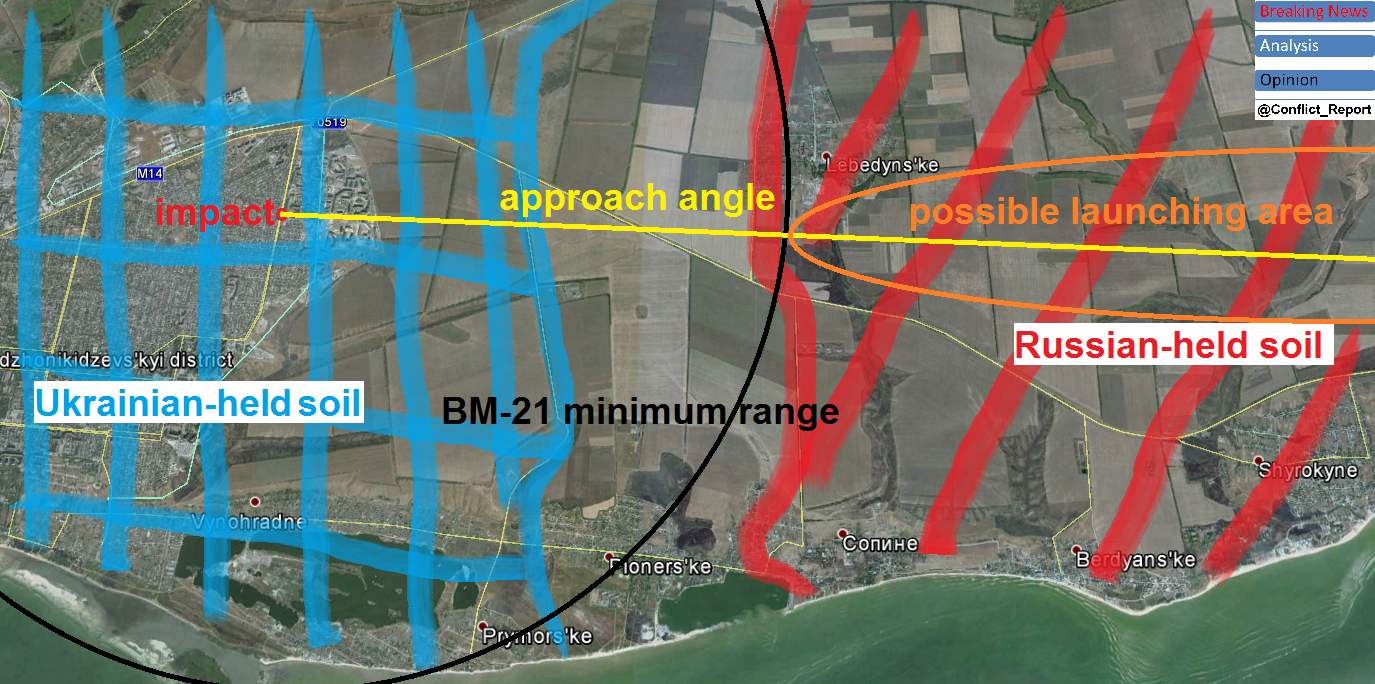
Strategic map
This area was directly invaded by the Russian army in August 27 last year, transferred to “none-professional” Russian invasion forces and a tiny number of local separatists during several months of the ceasefire and in late December reoccupied by a large Russian army force, preparing and starting an coordinated push with units all other the front since then. Simultaneously, the Russian force accumulated large quantities of weapons like the type of MLRS used in today’s attacks on Mariupol. Weapons which in its mere number and infinite resupply of ammunition can only be provided by a well-orchestrated military and logistic campaign on a national level.
In the end, the answer to the initial question of “Who caused the Mariupol massacre?” can be given with a certainty of 100%, looking at the comprehensive though straightforward analysis above: The armed forces of the Russian Federation. This is just another chapter in its aggressive and inhuman campaign vs. eastern Ukraine and the values of the international community which must be answered immediately and stopped by all available means.
 Conflict Report