“The Battle of Shaykh Maskin” – in depth war reporting, using the tool of footage geolocation

Introduction

If someone would ask me for the way from the main intersection in Shaykh Maskin’s to the north eastern hill where the Brigade 82 headquarters are based, I could probably give him directions without ever having been in the city or even the country. Moreover, I would be able to tell him, until what point he would be moving in rebel territory and at which street, he would have to choose whether to take cover or run over to the Assad regime side… No one will ever ask me and I won’t give directions.

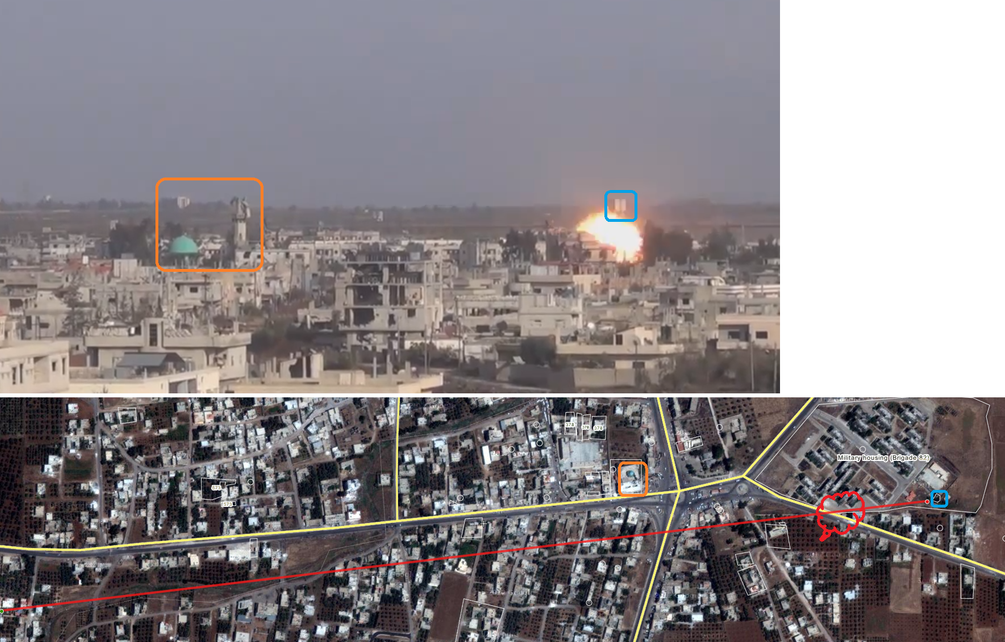
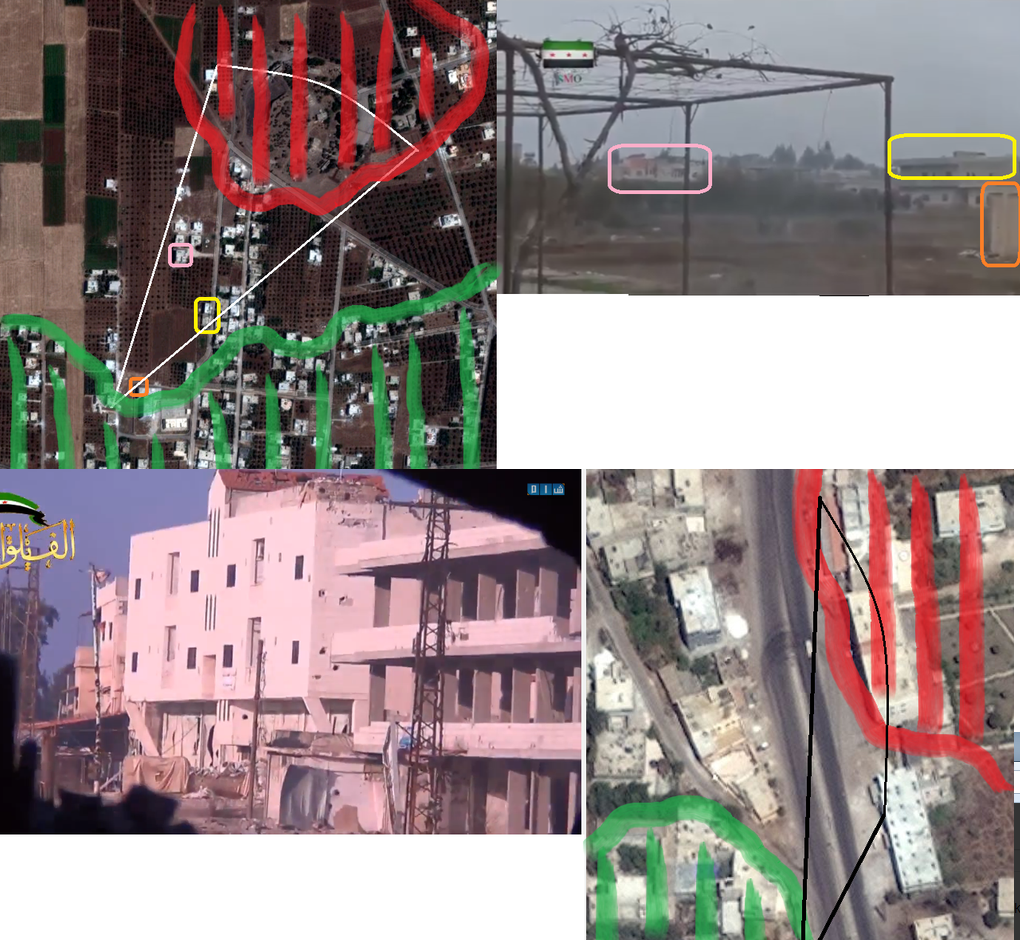
The point I want to make is that by reviewing multiple video angles of the town from recent rebel footage and comparing these with google maps and bing maps satellite images, I got able to tell, who is watching from which point into which direction and what this means for the viewer and the sighted objects.

When it comes to reporting on war, this analytical process, called geolocating, can turn out to be extraordinarily important as it allows to determine fighting action on the meter exactly, without relying on reports of either side of the conflict, whitewashing their “facts” in their particular favor in 99% of all cases (no offense as perfectly understandable). Moreover, it allows to follow conflicts closely and report on their progression, without risking one’s life. This becomes particularly interesting, talking about conflict zones, far too dangerous to send in neutral journalists.

Body

Coming back to the Battle of Shaykh Maskin, this fight serves as a perfect example for tracking frontline developments in an urban warfare situation from social media footage. I will describe how the battle proceeded, solely using my analyzed and geolocated rebel videos over the last 7 weeks. Altogether, I included some 200 videos from 15 rebel factions, ranging from Free Syrian Army brigades over moderate islamists from the Islamic Front to islamist fighters from Jabhat al Nusra, often described as a local branch of al-Qaeda.

In late October, Syrian rebels started their offensive on the Assad regime-held bases east of Nawa, resulting in the capture of at least 9 military installation between Nawa and Shaykh Maskin.

Nawa

Rebel gains around Nawa in early November, paving the way to Shaykh Maskin

These victories paved the way for the start of the offensive on the regime stronghold of Shaykh Maskin itself. While Nawa is the second biggest town in Daraa province, however not extremely strategically important beside that fact, Shaykh Maskin is the last regime-held city before the highway M5, which connects regime-held Daraa city with the greater Damascus area.  If it falls, Daraa city would be under threat of becoming besieged by rebels, which would result in the toal collapse of the Assad regime rule over its southern region.
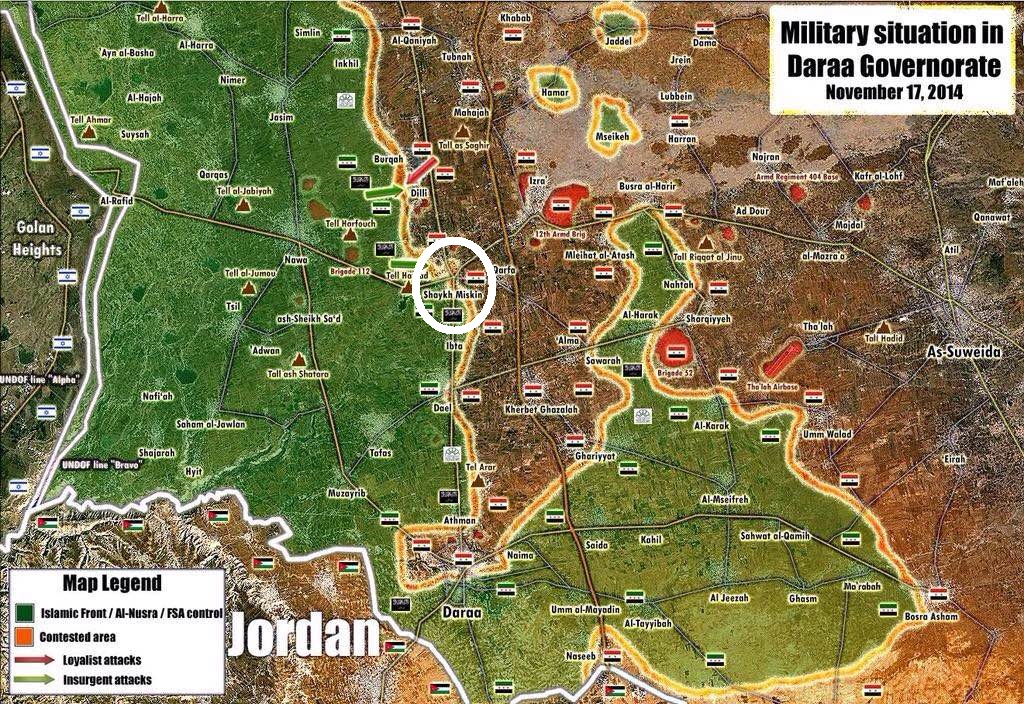
Daraa map

Map from mid November by @PetoLucem

The battle started November 1st, when rebels attacked the west and south west of the city. Due to the recent regime losses around Nawa, the defense of the city was weak and rebels forces needed only 5 days to occupy the entire south west. This enabled them tp launch an assault on the central intersection with the largest city mosque and main road barrier.
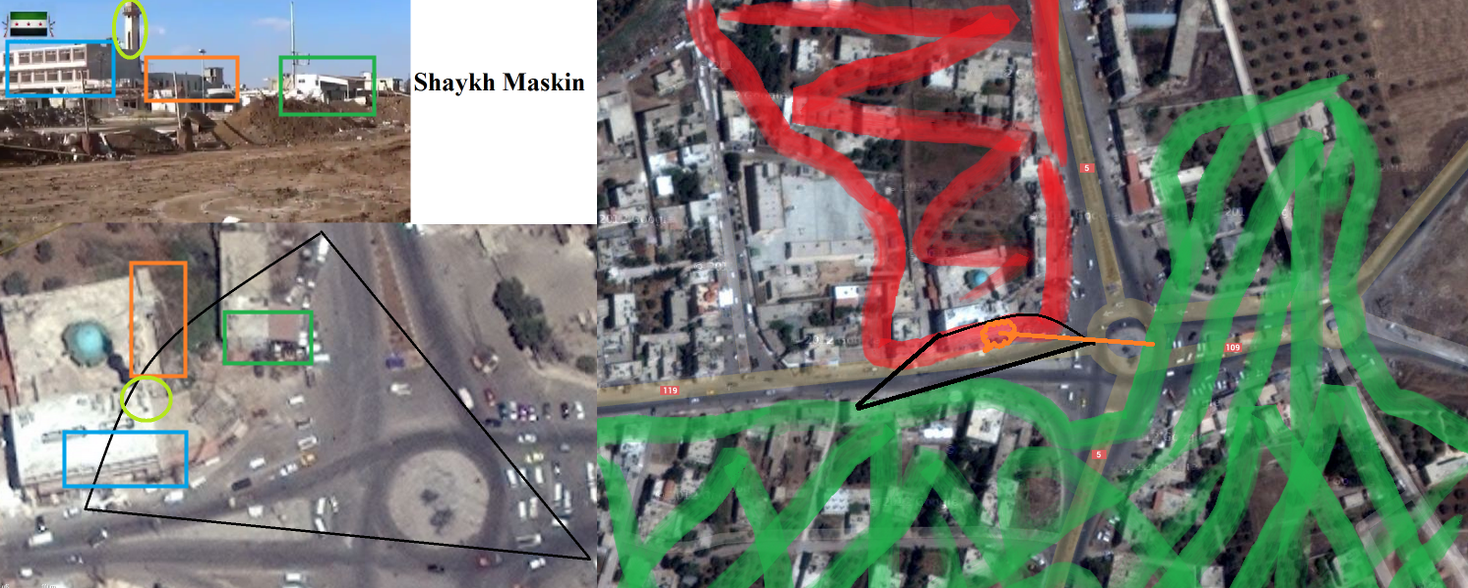
Shaykh Intersection

Rebel attack on central intersection barrier November 6

Shortly after the intersection and mosque were taken, however the Assad regime started to send reinforcements, coming from the east and north, so nearby towns like Izraa, but presumably also Damascus itself. Shortly after, rebels were in pssession of the mosque, but didn’t control the intersection anymore, from which they started their assault.

mosque taken

View from the taken mosque on the embattled intersection

At the same time, rebels tried to advance north, attacking the Brigade 82 headquarters of the city. However, due to massive Assad regime reinforcements, strengthening the different Brigade 82 complexes in the city, the rebel army started to face a two-front war, being attacked from the housing complex of Brigade 82, located in the south east, as well as the headquarters of the Brigade, located in the north. Additionally, regime forces were pushing down the north-south road, coming from the north east of the city, where there are several towns and wide strips of land under Assad regime rule. At the same time, Assad air force jets bombed rebel forces as well as civilian areas in the city, making it extremely hard to advance for rebels and even letting them lose some of the before-held territory.
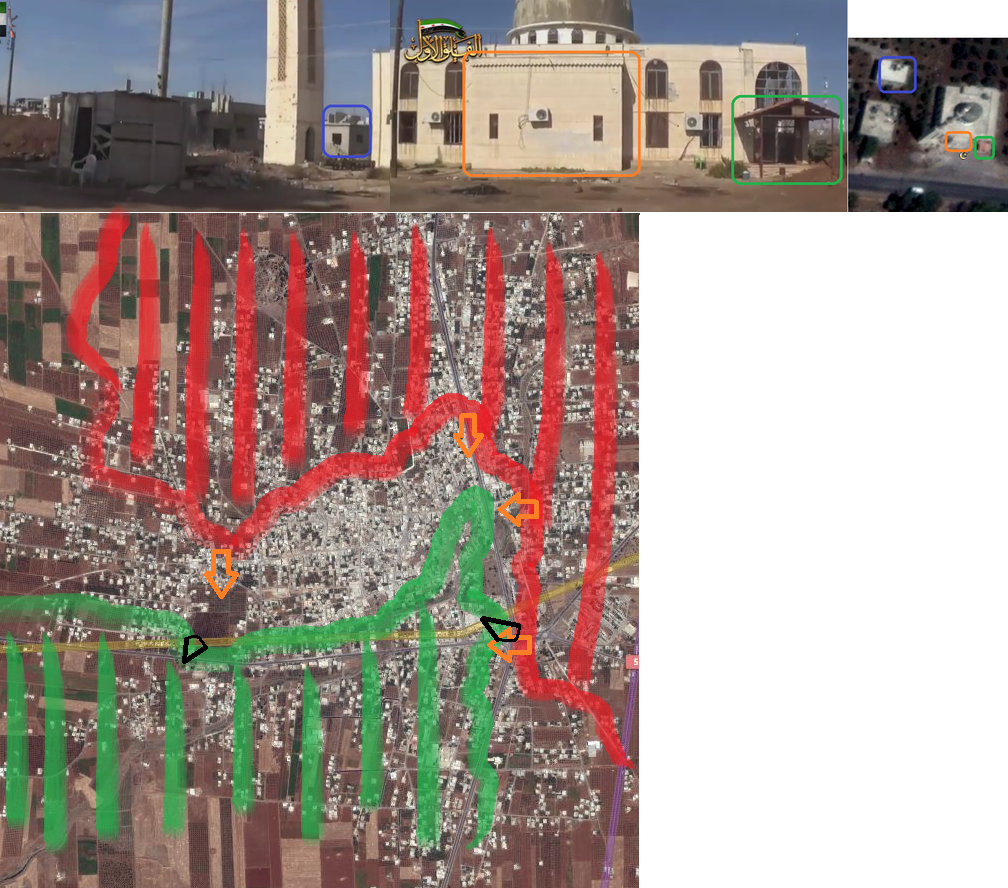
retreat

Regime counterattack, November 21

In this situation, only something dramatic could save rebels from being entirely pushed out of the city and towards Nawa in the west. This dramatic change came, when strong reinforcements from the Jabhat al Nusra islamist extremist group arrived in the city in late November. They added what moderate rebels, using advanced weapons (like the Saudi-supplied TOW), needed to succeed: Manpower and “absolute devotion”, meaning the willingness to not just win and survive the battle, but also sacrifice for this goal as a tactical mean … talking of suicide car bombers.

On December 7, two suicide bombers, using BMP ambulances rammed their vehicles into the Brigade 82 housing compley, destroying wide parts of the base.

svbied1

First SVBIED, Dec 7

svbied

Second SVBIED, December 7

This massive attack did not only stop the regime’s assault from the east of the city. Furthermore, it enabled rebels to attack and take the housing complex, effectively returning to a one front war towards the northern parts of the city. The suicide bombings caused massive destruction, leading to the collapse of several of the Brigade 82 housing area barracks. Between 20 and 50 Assad troops died in the assault. The rest fled to Izraa and Garfah.

svbiedafter

Aftermatho of the double SVBIED attack.

A short Assad army counteroffensive on December 8  coming from the S-E was fended off and within a couple of days, rebels were in a far better position, being now able to focus on the northern parts os the city. The two maps for comparison show the location of the two suicide BMP bombs as well as the directions of the rebel assault after victory in the south east.
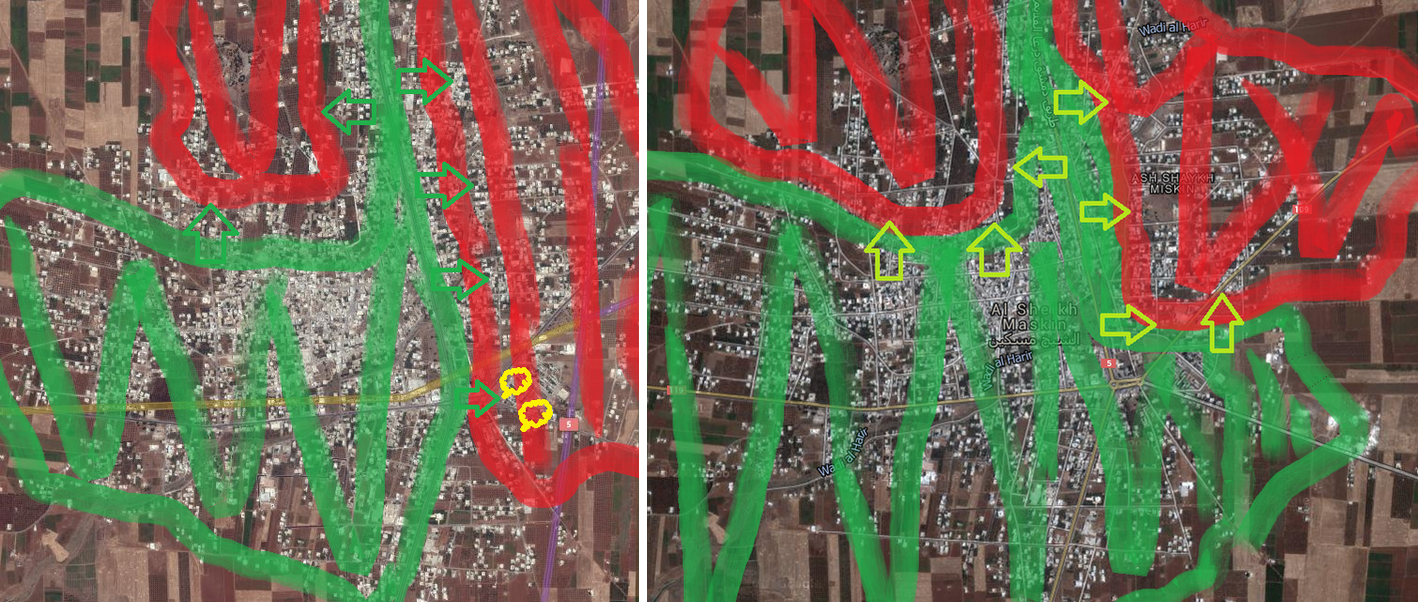
map after svbied

On December 9, the offensive on the Brigade 82 headquarters got intensified. Using small arms, mortars, but also ATGM and TOW, rebels launched hit after hit vs. regime troops, which were – and are – still resupplied from the north and the north east of the country. It becomes clear that no quick victory, like it was seen in the south east, is in sight in the north. Partly due to the superior position of Assad forces on the two heavily fortified hills, partly because Jabhat al Nusra seems to have withdrawn again from the battlefield, taking its 100+ men with them, leaving the offensive to not more than 300 FSA and moderate isalmist forces.

brig82-1

Territorial gains for rebels during the first half of December 2014
brig82-2

Attacks on Brigade82 and the eastern side of the main N<>S road

Despite tough battles and very slow rebel advances, progress for rebel forces is visible and the chance of Assad bouncing back seems very small.

On December 18, a number of videos appeared, making it possible to geolocate the current frontline in the city, slowly but continuously moving northward, indicating the liberation of another city from the grip of the Assad regime. At the same time, there is still heavy resistance from fanatic Assad-supportive troops, willing to risk everything for their loyalty to the country’s dictator. One indication of a long battle ahead is the – possible – recapture or eager hold on one high rising sniper position, very close to the center of the town.

brig82-3

View on the Brigade 82 hq and strategic situation map on December 18

However the sooner or later coming total defeat of the regime in Shaykh Maskin does not mean an immediate ease for the inhabitants of the town as the Assad regime follows the policy of scorched earth, bombing all lost areas – from the air – even harder than during military engagements in the respective territories.

Conclusion

The article at hand summarizes the footage analysis and locating work of more than 7 weeks. It shows that geolocating footage from ongoing battles and too-dangerous-to-enter war areas can lead to a deep understanding of the regarding conflicts in a journalistic as well as military-strategic respect. Therefore, I will continue using this instrument as a main tool of my work, trying to make sense of ongoing conflicts and describe them beyond “reported” or rather “claimed” and thus doubtful communiques from the involved actors on the ground. Last but not least, the battle for Shaykh Maskin is not over yet and I will consider writing a “part 2”, in case of decisive developments on the ground.


All sources in my Twitter feed between November 5 and December 18.

“The Boy who cried wolf” – my interview with the BBC at the turning point in Ukraine

At the 21st of August 2014, I was contacted by Vivienne Nunis from the BBC World Service, asking for an interview on the current situation in eastern Ukraine.

Although, the battle for Donbas was raging on for almost 4 months at this point, the general expectation was that the Ukrainian army was advancing and – after the recaptures of towns like Sloviansk, Kramatorsk and Lisiciansk – was close to retaking Luhansk and Donetsk city, which would have brought the majority of the population of Donbas back under Ukrainian government control.

Instead, it had decided to bypass these metropoles and instead try to recapture the entire borderline between Ukraine and Russia, seemingly still thinking, there was an influx in fighters and equipment ongoing, but no direct involvement of the Russia Federation’s armed forces was looming on the horizon. As most of us know today – it was dead wrong.

Already two weeks before this date, the first T-72B1 (video-evidently) turned up inside Ukraine, tanks that – different from the until then supplied old sotcks T-64 – were still in active service by the Russian Federation’s army and which the country would never have “presented” to “rebels” abroad, not being sure that the operators of those modern battle tanks were trained enough to properly use them on the battlefield.

However at this point, several days before the end of August, most of the relevant actors, including the EU and the Ukrainian government as well as wide parts of the public, did not believe or at least did not communicate, that Russia had already gone far beyond logistical support of – few and weak – local insurgent forces as well as “volunteers”, being drafted and deployed to eastern Ukraine from Russian regions like the Caucasus or the wider Don region with its “Cossack” minority community.

At the same time, I was covering the conflict as detailed and beyond mainstream sources as possible, analyzing and geolocating people’s footage, showing large columns of – manned – Russian weapon systems streaming into cities like Krasnodon and Thorez, both, near to the Russian border and strategically located near Luhansk, resp. Donetsk city.

I pointed out that the observed T-72, BTR-80A as well as BMP, MT-LB and a wide range of artillery pieces were only the forerunners of things that would follow shortly. For this pessimistic – and widely contrary to the Ukrainian army-published constant success messages, I was almost daily called the proverbial “boy who cried wolf”, who overdid military developments on the ground and was – if at all – crying “Russian invasion!” far too early.

However, some attentive people – like Vivienne and her bosses at the BBC – had the presentiment that most of the public had a wrong impression of what was really going on in the eastern Ukrainian border areas or at least thought it would be wise give a voise to those, opposing the general public opinion. – So I gave the interview at the 23rd of August, clarifying that already at this point, some 100 Russian T-64 main battle tank had entered Ukraine and more modern equipment was entering at this very moment. I also felt the obligation to say, that because of this, it was misleading and simply wrong to speak of “separatists”, but the only possible accurate wording was to call those forces “invaders”.

Although the short interview didn’t allow me to further go into detail, I think I made it clear, that we are not dealing with a local insurgency, but a foreign-led invasion, happening in eastern Ukraine at this time and gaining strength by the day.

Within the next 7 days, it turned out, I was WAY OFF from “crying wolf” and Ukraine and the free world paid a heavy price for not listening to a small group of people, being aware of the real sitaution on the ground …

A massive Russian army invasion started from exactly these areas, we predicted them to come from. The Ukrainian army strongholds of Savur Mohyla, Ilovaisk and Luhansk airport fell and with them some 1000 Ukrainian soldiers, a number, Europe has not seen in such a short period of time since World War II.

The below maps shows the (official Ukrainian army-reported) strategic situation, at the day of my interview with the BBC and today.

21.8.201415.12.2014

As you can see, “crying wolf” where there were tens of thousands of wolves, invading the Donbas region, didn’t help as there was either no political will to treat the situation as what it was (and still is!) or political incompetence, leading to the most crushing defeat of a European army in the 21st century.

Four months on, we are in another “ceasefire” that cost far more than 1000 people their lives, have a de facto pro-Russian regime in eastern Ukraine and still no political will to regain the lost land or – at least finally call a spade a spade.

What does this tell us for the future?

1st: LISTEN to people, opposing the common opinion in security-related issues, especially when they have inside information, mainstream media and seemingly even government intelligence do not have or is not willing to use.

2nd: Do not repeat mistakes, you have made once. Until the very day, Russia is claiming, it is not involved in the Ukrainian conflict and not responsible for the death of 1500-2000 Ukrainian soldiers, national guard troops and border patrol forces as well as thousands of civilians. They lied then and they lie today, which is such as evidently that even former close allies – like several European governments – are not willing to buy those lies anymore and put a range of sanctions on Russia, punishing its “meddling” in Ukraine.

3rd: Follow the example BBC and other established mainstream media companies, letting citizens and especially citizen journalists have their say, although it might contradict what most people think is “real”. Sometimes only a few boys (and girls) see the wolf coming.

AUDIO FILE: My interview with the BBC on August 21

A ceasefire to lose it all?! An analysis of the latest military developments in Ukraine.

This morning, the Ukrainian president Poroshenko had his first public appearance in Australia.

14.000 kilometers away from his country, he claimed: ” Today is the first 24 hours for seven months… when we have a real ceasefire in Ukraine.” and he continued: “You simply can’t imagine how important it is for me. This is the first night when I don’t have either a lost or wounded Ukrainian soldier.”

But is his optimism justified? Is there really a ceasefire in eastern Ukraine, which saw death and destruction by Russian aggressors over the last 7 months? Or is this just another silence before the storm, like the it happened in June and September for instance?!

This morning, first report emerged of Russian forces, strengthening their positions near the strategic Bahmutki highway, which is partly controlled by Ukrainian forces and secures Ukrainian-held territory south of the Seversky Donets river in the Luhansk region (source). At least five tanks and several 2S1 self-propellered howitzers were seen taking up positions near Ukrainian checkpoints, without the Ukrainian army reacting to it, due to the “silence mode”, ordered by the government.

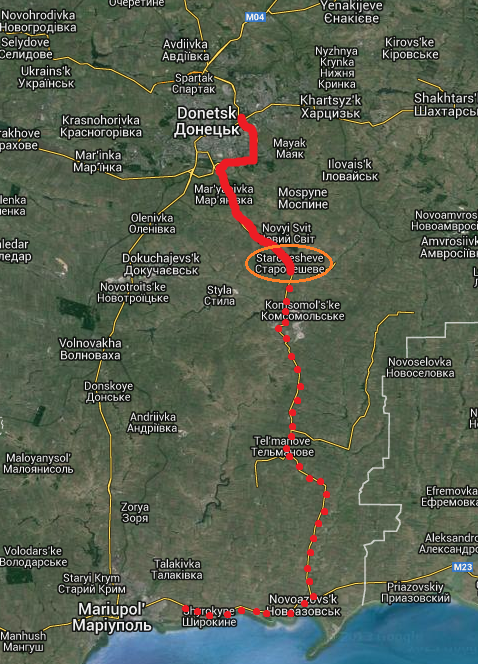
Then this afternoon, chilling footage appeared, seemingly showing a large Russian invasion army convoy, going from the Donetsk area to the southern city of Mariupol, which Russian forces tried to take in August, but were stopped some 5-10 km east of it. The convoy was probably filmed near Starobesheve, as shown of the map.

map

Possible path of the filmed Russian column

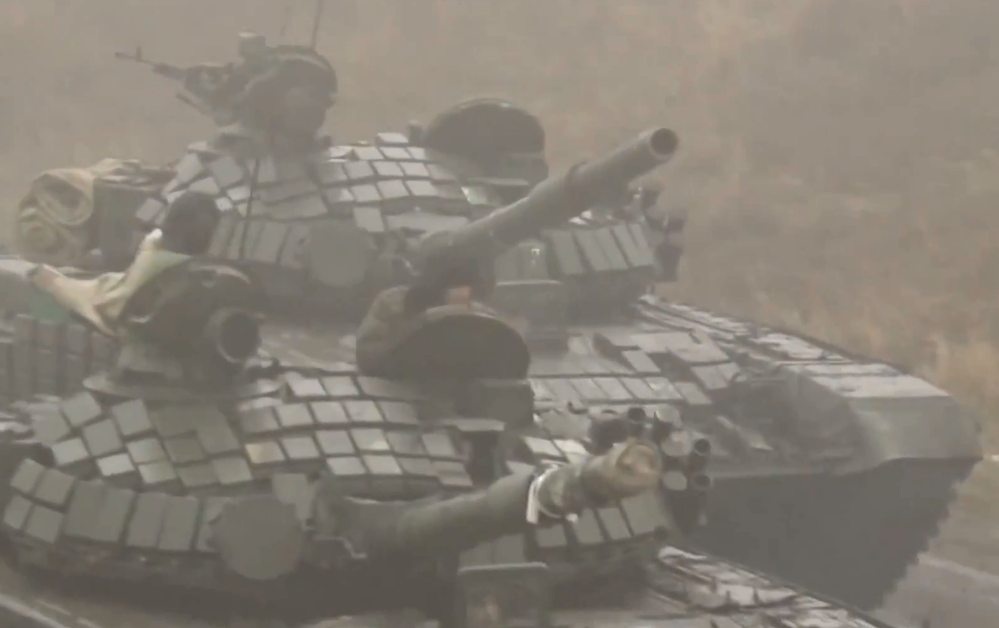
The footage shows dozens of modern battle tanks, namely T-72B1 and T-64BV, all brought to Ukraine by the Russian army via trains and low-loaders from all over Russia (as proven before by the Russian railway H2200 markings for heavy equipment on top of its wagons. The convoy also included a double-digit number of BMP-2, BTR-70, BTR-80 – all of those infantry fighting vehicles and armored personal carriers – as well as dozens of Ural and KamAZ trucks, transporting troops, ammunition and some of them towing field artillery pieces of different types.

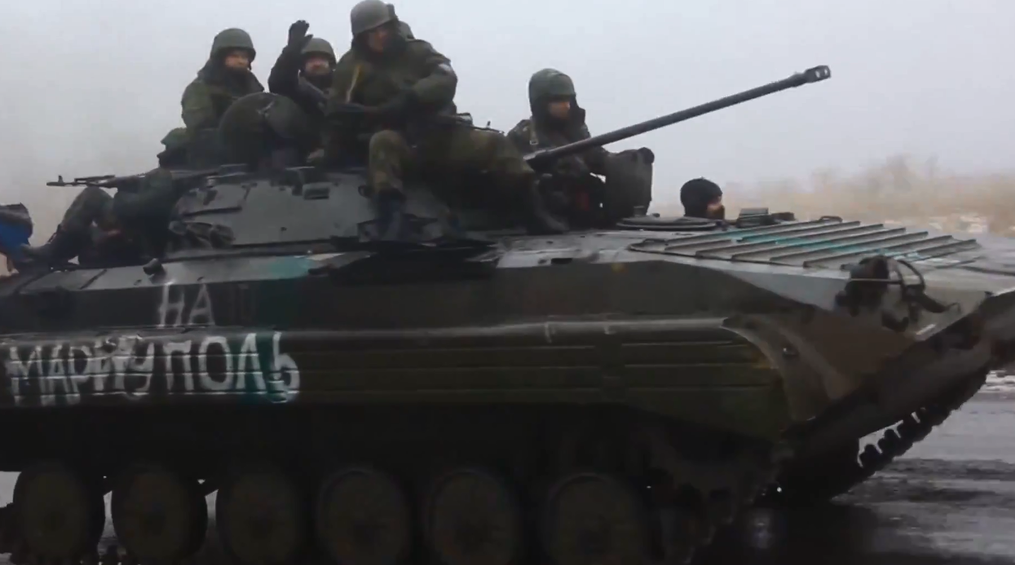
Last but not least it should be mentioned that many of the armored personal carriers caried the writing: “TO MARIUPOL” which seems to be hard to misinterpret.

The following pictures show some of the weapon systems in the observed column.

bmp-2

BMP-2 with “TO MARIUPOL” written on it

T-72B1

Two T-72B1 main battle tanks

T-64

T-64BV main battle tank

Ural with artillery

Ural trucks, towing artillery

So what to make out of these obvious massive redeployments of Russian forces inside occupied Donbas?

Regarding the large column, seen yesterday, there are three possible alternatives, why they left Donetsk towards the south.

1. It is possible that these vehicles and the involved troops are actually not going to Mariupol but back to Russia, using one of the Russian-controlled Ukrainian border posts in south eastern Donetsk oblast or the “green border”. The fact that these troops are so willingly showing their “real intention” – “to go to Mariupol” raises suspicion, if they are really so confident that they will give away all strategic advantage by not telling spectators, the internet – and by this the Ukrainian army, what they are planning right now.

It is possible that the Russian regime – in its attempt to fix and calm the situation in eastern Ukraine – is withdrawing its “victorious” forces, however not willing to show that without any propaganda.

2. As I have argued over the last weeks, large Russian army movements and reinforcements to certain areas inside Ukraine do not automatically mean that those troops shall be used to fight Ukrainian soldiers, but to control and – if necessary fight and kill – “rogue” (pro-)Russian units, which have too high aspirations for the advance inside Ukraine (“Odessa” or alike) or are not willing to obey orders from the “rebel” military leadership in Moscow.

There were several reports of Russian forces shelling each other east of Mariupol over the last 2 months, reports of Russian army forces retreating to Novoazovsk and only badly equipped volunteers or even locals holding the frontline, 5-10 km from Mariupol.

3. … and this is where we are coming back to the initial question: There is a – huge – possibility that the entire latest “ceasefire” in eastern Ukraine – which was never fully accepted or even implemented by ANY of the anti-Ukrainian factions, is solely used by Russian aggressors to prepare for the next – even more daily and brutal – round of fighting. These preparations could be made to take – as the leaders of the two “Peoples’ Republics always promised” to prepare for the battle that would aim to take all of Luhansk and Donetsk oblast and reach possibly even further.

In this case, what we hear and see since the start of the latest ceasefire on Tuesday is a tactical redeployments and strengthening of troops, equipment and positions to simply break it another time and hit the Ukrainian army and people as severely as never before. In this context, the arrival of another – 120 vehicle – “aid” convoy in the Donetsk and Luhansk regions this morning could be another sign of escalation, knowing these convoys transported military equipment to local forces before.

Also in this context, the massive Russian military column that was seen yesterday and described above could indeed by the Battalion-size force which is to take Mariupol and the surrounding areas in the weeks and months to come. Although, there is a massive Ukrainian army force west of Donetsk, Russian invaders could have realized that they can rely on Poroshenko’s word and he won’t start any counterattack, no matter what. Knowing this, Russia could have decided to redeploy several hundred troops plus a mighty apc/tank/artillery force to the south to extend its controlled territory on the northern coast of the Sea of Azov.

President Poroshenko’s policy – still – could be the smartest possible one, not provoking further aggression from the Russian side. However, there is a certain chance, his political and military restraint will be interpreted by weakness by the rulers in the Kremlin and their proxy forces in occupied Donbas, which could lead to Ukraine, paying the highest price for its current appeasement policy.

Source tweets by me:

Tracking the Islamic State’s advance towards Deir Ezzor airport

Islamist terrorists and airplanes make a bad mixture, which is not only known since the 9/11 attacks. This might be one reason, why advances of the so-called „Islamic State” on airports are monitored with even greater concern than its general military gains – and losses – in Syrian and Iraq.

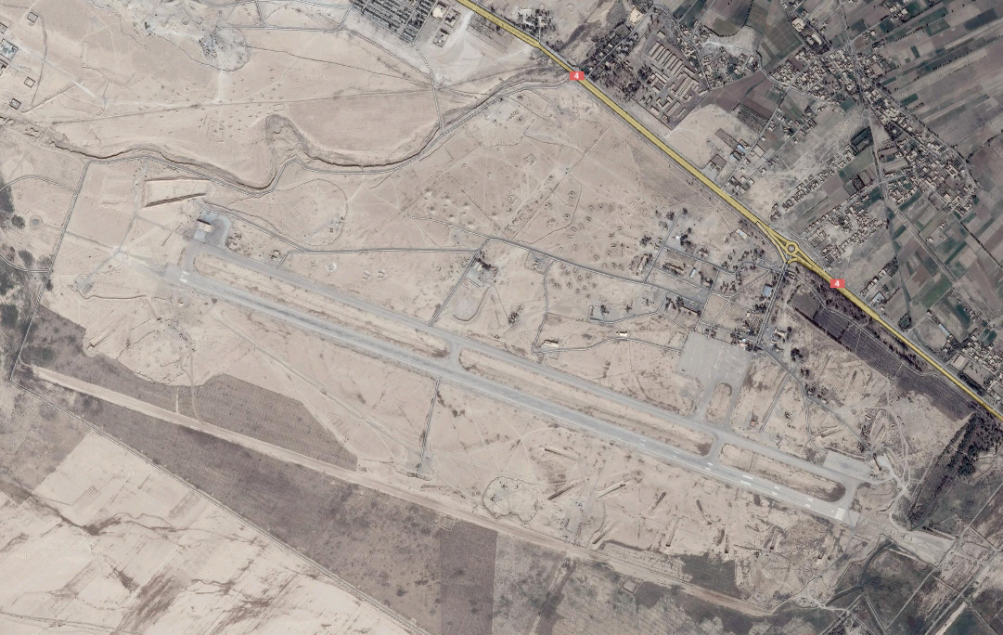
Despite the fact that the Islamic State controls some three to four landing strips in the two countries and was never able to start a single manned aircraft from these, its well-known assault on Deir Ezzor airport (map below) is not just a worry to the Assad regime, which holds it right now, but also to regional and western strategists, fearing fighter jets, helicopters as well as loads of heavy and advanced weapons could fall into the IS’ hands.

1The airport of Deir Ezzor

The Islamic extremist organisation is controlling wide parts of Deir Ezzor city since months, which is located north east of the airport. However vague reports emerged over the last weeks, its troops are directly advancing on the airstrip. While this was harshly rejected by the Assad regime ministry of information, western intelligence agencies as well as major news portals had no information on the issue for weeks. On the other side – always “optimistic” – written claims by the terrorist organisation itself normally cannot be checked and thus have to be taken as unconfirmed, mostly exaggerated propaganda.

Therefore to get to know the real extent of the territory the IS controls and the gains or losses they make remains only one promising way, which is the geolocation and analysis of their posted videos.
Doing this over the last days I discovered that their advance on the airport itself moved further than most people expected (scroll down for my source tweets). By precisely geolocating their videos it can be observed that they bypassed the city itself, advanced from the south east and took up positions, which are only 300 meters away from territory of the airport itself and not more than 600 meters from the runway and apron (see map below).

2Identified IS positions near the airport

Given the fact that they seem able to hold these areas for days or more, two different conclusions can be drawn.
First, the Assad regime forces in the area seem to be thinned out and not strong enough anymore to counterattack these strategic positions and push back the IS troops from the perimeters of its airport. This is a telling aspect as it suggests, Assad as well as IS troops have approximately the same military strength in the area. At the same time both sides are weakened from battles at other frontlines, which do not run to their favour.

Second, it can be assumed that at least fixed wing aircraft are not able to approach or take off from the south eastern direction of Deir Ezzor airport anymore as IS troops have positioned heavy machine guns in the area. These would be a far too big threat to low-flying aircraft. This means that – at least for now – the Assad regime cannot use its biggest advantage in the war in Syria, which has always been its air force.

Finally, some final conclusions can be drawn from the most recent developments in the area. While the current advance and possible takeover of Deir Ezzor military airport by the Islamic State might be no big challenge for western governments and might not increase the threat level of aircraft-related terrorist acts, it might deal a deadly blow to the aspirations of the Assad regime in eastern Syria. The fall of Deir Ezzor airport would further weaken the Syrian dictator’s regime in an area, he already lost significant stretches of land and has little to no resources to fill up its thinned out ranks.

Last but not least it has to be said that without the detailed geolocation of recent IS operational videos from the area, no reliable information at all would be available and no conclusions could have been drawn.


Source tweets, featuring the conducted analysis and geolocation of the IS video:

https://twitter.com/Conflict_Report/status/542743194371620865

https://twitter.com/Conflict_Report/status/542717145600499712