The inevitable – Russian troops enter the last Ukrainian stronghold at Donetsk airport

“The situation is under control” –  this phrase was used by the Ukrainian government/army:

in September when the attack began and Russian forces took all hangar buildings,

in October, when they seized Terminal 2 for several times,

in November, when Russian shelling and destruction mounted,

in December, when Terminal 2 were handed over to the invasion army peacefully and Russians took up perfect offensive positions beside Terminal 1,

on January 5 when Ukrainian intelligence services announced fresh  Russian army formations arrived to surround and take the airport as the top priority,

on January 12, when new Russian ground forces showed up in Terminal 2, announcing to do exactly that,

on January 13, when the badly damaged tower collapsed under intense artillery and tank fire in the morning and Ukrainian troops stopped a first Chechen infantry push in the basement of the last Ukrainian-held terminal in the evening

AND on January 15 – today – when Russian invasion forces finally stormed the terminal and are fighting Ukrainian troops inside it since 7 hours now.

The situation is NOT under control. It is out of control since the Minsk agreement, which has NEVER been a mutual ceasefire as agreed on, but always an unilateral truce, only adhered to by the Ukrainian side. Nobody should be surprised now. Russian invasion forces didn’t attack Terminal 1 by surprise, they advance since 5 months. Every month. Steadily and without major setbacks. This development was observed and well-documented by dozens of analysts and – of course – also by the Ukrainian army, which lost its freedom of movement / building after building / man after man in the area of the airport since September last year. However for a reason that can only be called deliberate blind appeasement policy, the Ukrainian leadership decided to let Russian forces advance over a period of about 130 days, pretending “the situation is under control”, which now should be clear to everyone, it is not.

At the same time, president Poroshenko connected the defense of the airport inseparable with the defense of entire Ukraine, saying December 5 that the defense of Donetsk airport actually is the defense of Kiev and Lviv. Losing the airport means losing Ukraine. Knowing this, it is even less understandable why he accepted the Russian advance for the last 5 months, without implementing any forceful countermeasure.

So his afternoon, the inevitable happened. Under intense tank fire from Spartak and Vesele plus artillery and mortar support from all across Donetsk city and Makeevka, Russian infantry forces stormed the ground floor of Terminal 1, coming from nearby Terminal 2. Remember that this 50 meters away building was transferred from Ukrainian to Russian troops peacafully in early December as it was allegedly “destroyed and not usable as a strategic position” anymore. Another misjudgment, obviously.

old new

Russian troops, walking from the old into the new terminal without resistance.

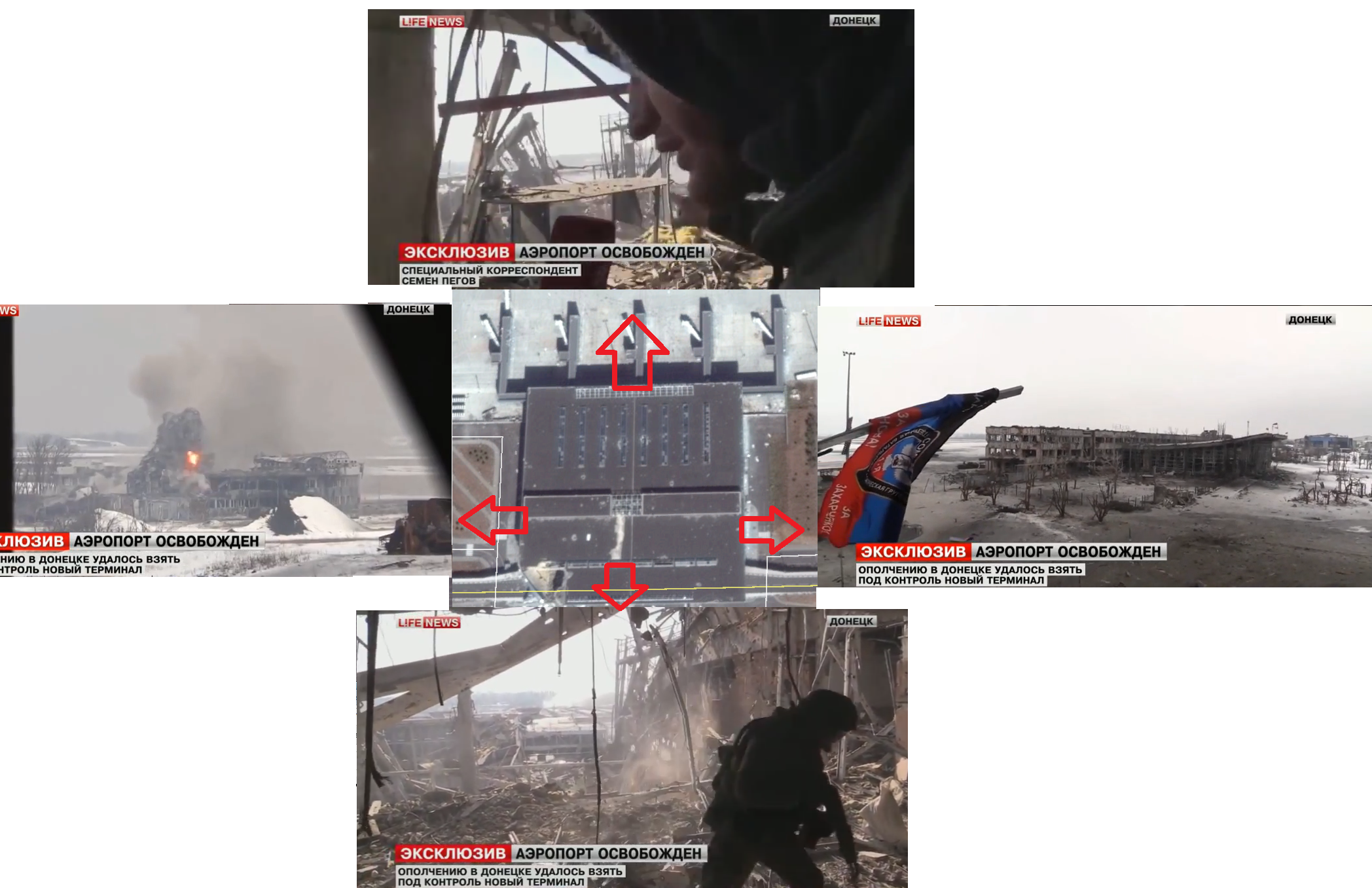
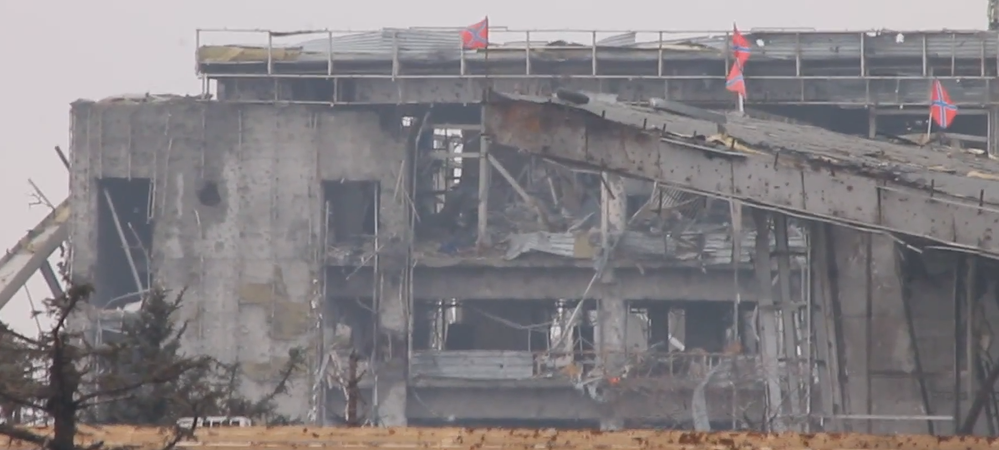
While the actual attack was not caught on camera, Russian TV published first images shortly after, showing its forces controlled practically the entire second floor of Terminal 1, offering views into all four cardinal directions. Parts of the apron, the car park, the destroyed tower and Terminal 2 are clearly visible in the footage as can be seen below. At the same time, Ukrainian forces in or near the airport reported they also fought invasion units of “battalion size” (so more than 300 soldiers) that entered the basement and the 3rd floor. Indeed Russian TV footage showed them changing levels inside the terminal, looking all across the large entrance hall of the terminal and firing up and down stairs within the building. Last but not least to enter the 2nd floor as the Ukrainian government confirmed, they must have passed the ground floor and 1st floor at some point. So in conclusion it is fair to say, battles between Ukrainian forces and Russian invaders took place all across Terminal 1 at the afternoon of January 15.

all directions

Views to all sides


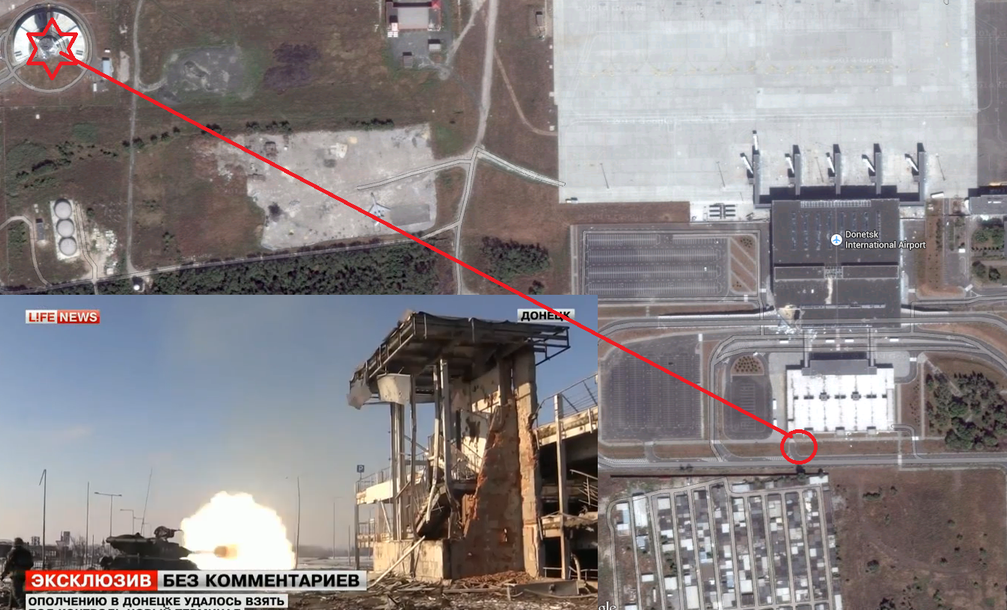
But Russian troops were not just inside the Terminal. The nearest possible Ukrainian defense position is located at the ruins of the tower buildings, some 870 meters to the west. Russian tanks and ground troops moved all along south of Terminal 1, passing it and coming in a position to fire at the remains of the tower from that range. This way, they could cut Ukrainian reinforcements from Pisky and the tower – at least for a while.

tower

Russian T-64, firing at the tower ruins.


At 21:00 that day, one of the defenders announced via Facebook that over the afternoon and evening they were able to “take up positions in all floors” again with the help of arriving reinforcements. Moreover artillery ran off the attacking tanks and they could evacuate their dead and wounded (at least 2 KIA, 7 WIA). However the message included the famous phrase that should cause everybody to be terrified of the next days: “The situation is under control.”*


Please support my 15/7 work with 1 $ per month or more. Thanks a lot!

* respectively: “The situation is more or less stabilized.”

A deadly chain reaction – making sense of the Volnovakha bus massacre

In the early afternoon hours of January 13, one of the most deadly single incidents during the Russian aggression in southern and eastern Ukraine hit a bus near a police / border guards checkpoint at the northern outskirts of the Ukrainian city of Volnovakha.

Shortly after the tragedy, a (graphic!) video appeared on YouTube, being widely assumed as the main evidence to find out, what happened to the bus and – the main question – who caused that massacre on innocent civilians. However, different versions of sense making appeared, seemingly contradicting each other. One of a Russian-fired missile or artillery round, hitting the area around the checkpoint and causing the carnage, published by pro-Ukrainian analysts; one of an Ukrainian mine, hitting the bus, leading to the senseless deaths; published by pro-Russian activists. Since then the two factions are confronting each other with their evidence, blaming the other side of lying. This short article argues that both are partly right and there is common ground between them, explaining the massacre.

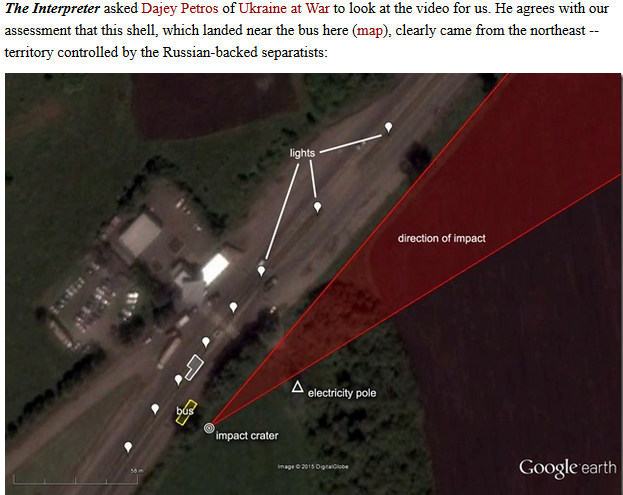
Within a couple of hours, interpretermag published a report, convincingly illustrating that a rocket or artillery round, fired from the Russian-held Dokuchajevsk area to the north east, hit just right of the bus, causing the disaster (image below). Both the impact crater and the damage on the ground support this argument, which can not be refuted.

version1

Source: The Interpreter, analysis by Dajey Petros

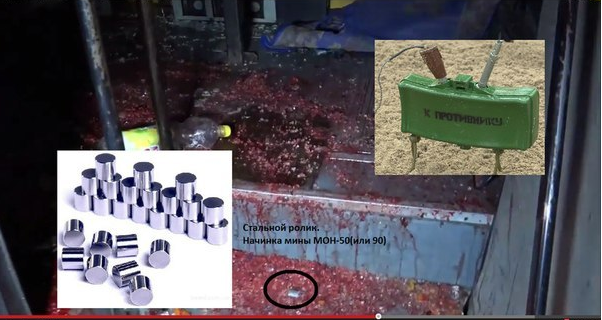
Shortly after, a pro-Russian side published a report based on the same video, pointing out that the bus was very close to an Ukrainian mine field, an Ukrainian soldier could be seen, carrying and anti-personal mine just outside the bus and typical fragments of an Ukrainian-used MON-50 mine could be seen between the blood of the victims inside the hit vehicle (images below). The three aspects, despite not supporting the official Ukrainian version of the events, must be taken into account, trying to understand what caused the bloodbath.

Making sense of it all: From a fact-based analytical perspective, all surrounding circumstances must be considered, no matter of the political alignment. In this regard, both version are supported by facts and no obvious manipulation can be seen from my understanding. Hence the question arises, if both version are true and a combination of different fatal weapons – used by Russian invaders and placed by Ukrainian defenders – led to the deaths of 13 innocent people with several more still fighting for their lives in hospitals.

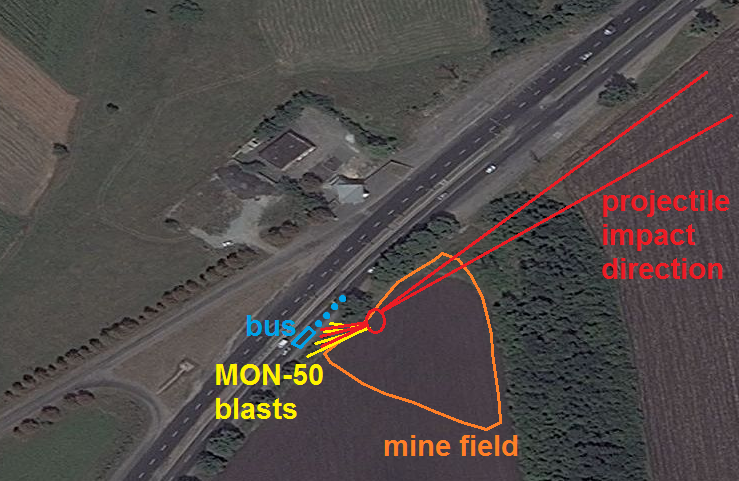
From all available data (video footage only, not statements by either side), it appears that the Russian-fired impacting shell hit the mine field to the right side of the bus, triggering a chain reaction by causing one or more of the there-put MON-50 to explode. Not in the intended direction – away from the street – but due to the impact power right towards the passing by bus, causing a catastrophe. Thus, BOTH, fragments of the Grad missile / artillery round AND of the thrown-up mines hit the bus in a totally uncontrolled manner, causing the visible damage, which could be seen in the aftermath footage. The subsequent analytical display portrays what could have happened within seconds yesterday afternoon, leading to imminent mass casualties. This conclusion seems most convincing as it includes all available evidence from the scene.

missile+mine

Source: own creation, based on Bing Maps

So who is to blame? The answer is obvious: The Russian side. They fired towards the checkpoint, knowingly that civilian vehicles would be queueing there, waiting to be checked before leaving / entering Volnovakha. By firing at the Ukrainian government checkpoint, they approved civilian casualties, once again showing their total disrespect for innocent human life and the “rules of war”.

At the same time, it must be concluded that the Ukrainian side unnecessarily tried to cover up that not only an incoming projectile, but mainly the accidentally triggered MON-50 mines (caused by the intentionally fired shell of course!) hit the chassis of the passing bus, causing 13 deaths. Ukrainian troops removed some of the mines – also simply to be safe during the rescue and recovery operation – and the Ukrainian government version doesn’t mention any mines involved in the tragedy. This behavior is – as I said – absolutely unnecessary and contraproductive as it produces doubt about the version where all moral arguments about the blame are on the Ukrainian side.

In conclusion, what we saw yesterday was another unprovoked act of violence vs. civilians by Russian terrorist and army forces, willing to advance at any cost. The Volnovakha bus massacre was caused by its deliberate actions vs. Ukrainian-held territory, leading to a deadly chain of reactions which killed 12 more Ukrainians in the Russian-led war.

Update #1

As many experts argue, I am wrong with my analysis, I took another look at the only known Grad impact location in the field and the location and external damage at the bus at this time. The missile impacted at least 10 meters from the bus, hitting deep into the snow with most of its energy. I see no chance, it caused the visible damage at the bus and plus 12 deaths inside it. There must have been secondary blasts, caused by triggered / hurled up mines, to cause such damage and casualty picture.

Unbenannt

bus-impact distance

PS: In the end, I can not say, which kind of mines were placed in the field, MON-50 or – maybe more convincing – other sorts of contact mines. However what I can say is that the official version (one Grad missile hit) does not add up.

Update #2

Meanwhile, more footage appeared and I did some more analyzing of the already known material.

At first, I took another look at the impact site yesterday. If the Grad missile really hit the area from an N-NE angle – and nobody doubts that – its main force should have gone to the S-SW. The impact area confirms this and shows that  most of the snow was burned in that direction, indicating that also most of the impact and explosive energy of the missile must have been directed towards this angle (picture below).

angle

impact direction towards S-SW

At the same time, the bus is located 7-10 meters to the N-E of the impact crater and only little snow is burned in that direction before and after the little mound on the side of the street. So IF the buse was hit by the main force of the missile, which would have been necessary to cause such carnage, it should have been some more meters down the road to directly “drive into” the main blast direction. A look at its front shows that this is not the case.

front

undamaged bus front

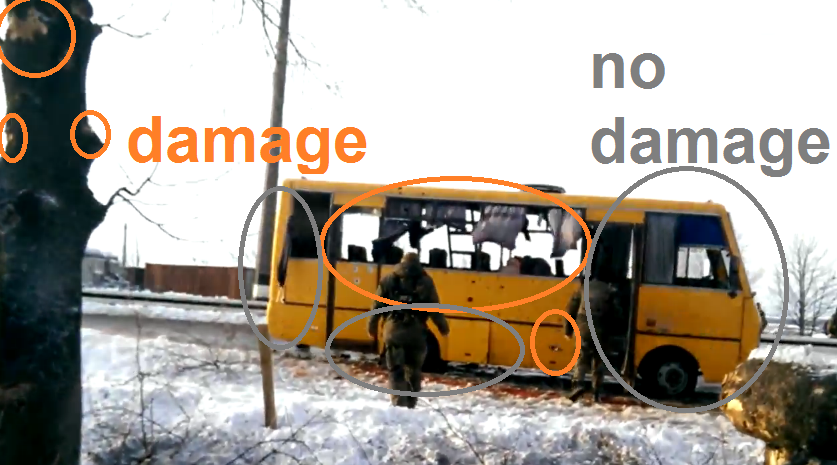
Thus, it must be assumed that the bus stood exactly where it was filmed when it was hit, so to the right of the main blast energy of the impacting Grad. A last look at the bus illustrates that the damage is not the same all over, but different zones show a different degree of external damage (image below). The “what cause what” mark is just an estimate of course. The main point is that such damage is very unusual for being caused by a Grad that hit a snowy field, 7-10 meters in a 90° angle to its impact. It is almost unthinkable that 20+ people got killed and injured by the Grad blast. The tree shows also blast damage, which could well be from the exploding missile. However this tree is only 1-2 meters away from the impact site, while the buse is located further away. In conclusion: It remains hard to believe the missile alone caused 12 deaths inside the bus, despite exploding too far away and not being “directed” towards the affected bus.

bus tree

bus damage

Last but not least, a video appeared, showing the Grad attack on the checkpoint that caused the deaths. Althoug the camera is directed towards the north and only captures the shadow of he bus blast, it contains an interesting detail. The missiles that hit nearest to the base – also close to the street and near the trees – possibly caused the same as what I am pointing to on the other side of the base, namely a secondary blast by a mine, located close to where the missile hit. While all other missiles – also impacting in the middle of the street – caused dark shallow smoke, this one caused a bright flash up in the trees accompanied by upgoing white smoke in addition to the black one. Althoug the images are blurry and no final conlusions can be drawn, this could be the precedent that makes my interpretation of the events yet a bit more likely.other blasts

All according to plan – Russia’s winter war was foreseeable

Many analysts an – much worse – seemingly also the Ukrainian government were surprised by the recent surge in violence in eastern Ukraine while most western media branches have not even noticed that Russia took its war against Ukraine to a new level with an unprecedented “increase in number and intensity of attacks” (the Ukr army).

Several number confirm that observation. While the first shaky weeks of the Minsk “ceasefire” in September saw between 30 and 40 attacks per day, that number reduced to around 10 (/day) in November and December last year. First analysts thought president Poroshenko’s appeasement policy towards Russia bore fruit, but during the first week of January, the Ukrainian army recorded once again around 40 attacks per day. This number increased more and more, reaching 50 and stands at more than 60 per day right now.

Another indication of the recent surge in anti-Ukrainian military violence is the number of Ukrainian army casualties. On December 9 2014, Petro Poroshenko proudly announced that the last 24 hours had seen not a single Ukrainian army casualty, seemingly supporting his “We stop shooting, they will follow” policy. But things turned out to be developing in the utter opposite direction. A new Russian offensive, starting on New Year’s day 14/15 brought more than a hundred Ukrainian military casualties, with the 48 hours from January 8 to 10 resulting in 34 dead in injured only to have just one example.

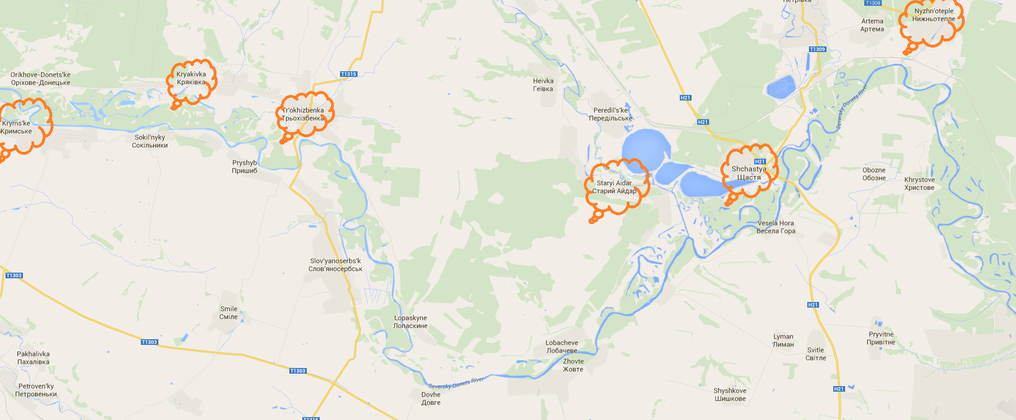
During the last days, the number of attacks became simply too high to count and the incidents are impossible to distinguish from each other, though, I tried as this “one-evening-MLRS-target-map” from the northern Luhansk front shows.

northernfront

Russian MLRS and artillery attacks on the eve of January 11

Instead the entire Ukrainian front in the Luhansk and Donetsk regions is under intense attack of all kinds of weapons, mainly heavy ones like tank, heavy artillery, Grad missiles and even BM-27 Uragan, which are might MLRS with a highly destructive potential. In one word, what we see since the last 2 weeks is not just an “extreme deterioration of the situation”, but war, simple as that.

But was this development really so unforeseeable?

At least two facts, one clearly visible, one invisible until very recently, show that this is nothing of the sort of a “sudden rise in violence” or an “unexpected flare in attacks” like many experts want to make us believe. Instead, I argue, this whole process goes exactly according to a precisely scheduled plan by the warmongers in the Kremlin, which are not at their target situation in Ukraine yet.

1. The obvious prologue

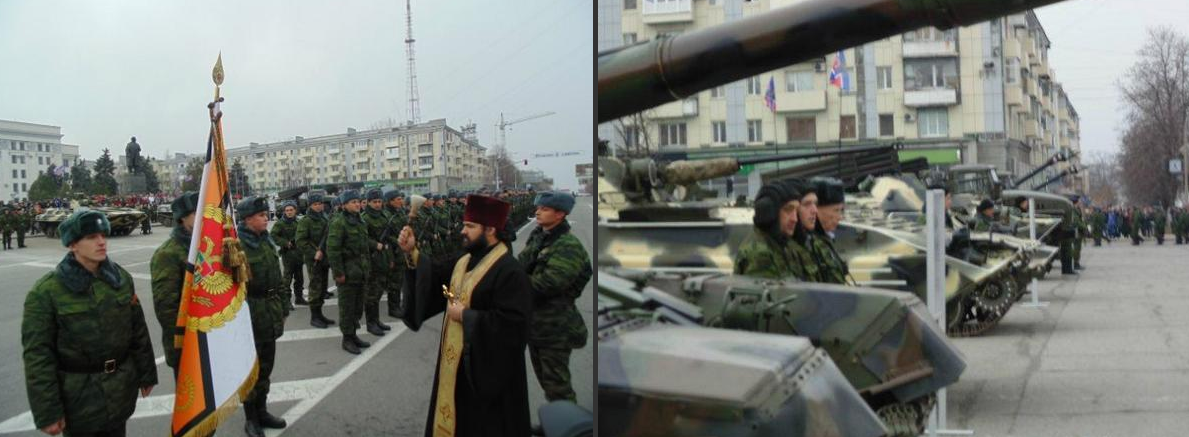
Everybody could see the influx of tens of thousands of Russian “volunteers” (paid mercenaries) and army personal. This did not happen during the last 2 or 4 weeks or under any serious cover, but at since late October and in brought daylight.

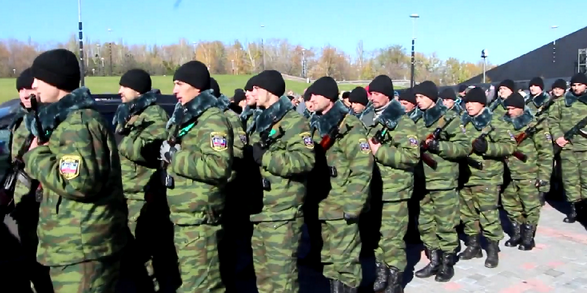
In late October, the first some hundred “little green men” showed up in Donetsk city, widely reflected by the online community and the Russian mainstream media.

donetsk

At November 1 for example, hundreds of – obvious – Russian troops with modern equipment showed up in Luhansk, parading through the city and openly declaring it under their control from then on (picture). These troops were strenghtened and spread throughout other cities, for example Krasnyi Luch where they showed up on December 12 with an even larger military parade.

luhansk

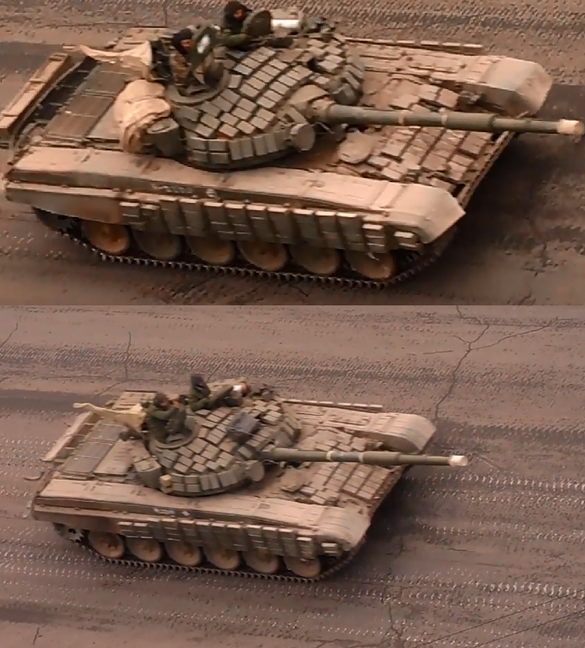
Shortly after on November 10, more heavy Russian army armor – T-72B1 – showed up on the streets of Donetsk, at a time, the Minsk agreement demanded “pro-Russian forces” to withdraw exactly these weapons from the buffer zone.

tanks

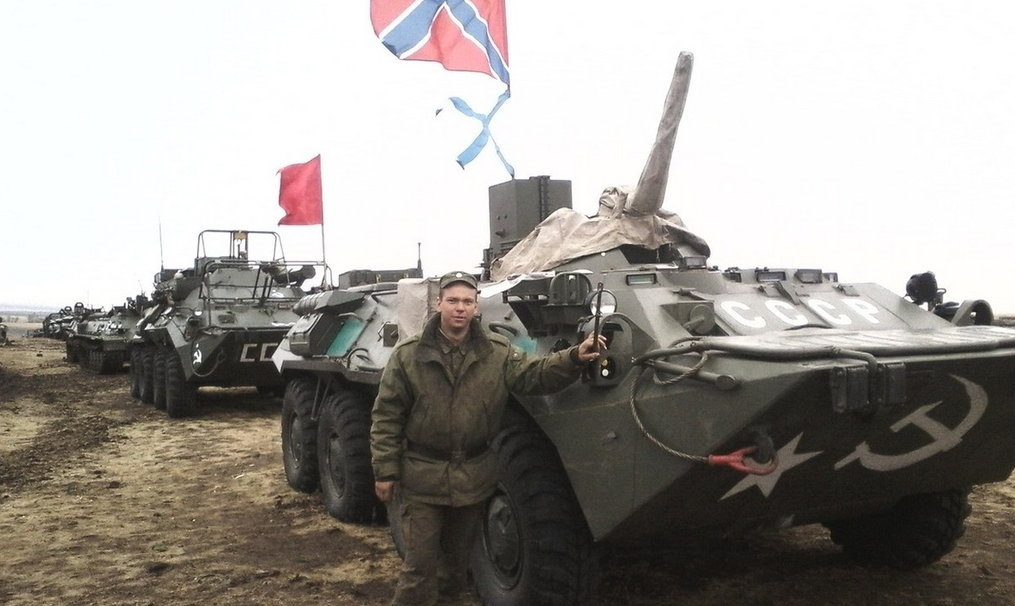
There are many more examples, also from as early as September when a 100+ Russian army KamAZ and heavy artillery convoy reached Donetsk city over several days. One more example is to be called as it seemed so unreal at this point that most analysts just went over it. In late November, an entire (Russian) army under the flag of “Novorossiya” and marked with Soviet CCCP signs waited at Ukraine’s eastern border – inside Russia!! – ready to invade. It obviously did shortly after.

cccp

In conclusion, no one could say in early December that Russia had not literally shouted, “We prepare for war inside Ukraine!” while some optimists – like me – still had another theory, seeing the invasion of thousands of Russian troops bright-eyed. But this hope – that Russia sent regular soldiers to calm down the situation and stop “rogue” militias from attacking Ukrainian soil  – was dead wrong. It sent them to control each and every anti-Ukrainian fighter, match them to one force under one command and be more fit for the decisive battle which would start 2 months later.

2. The invisible prologue

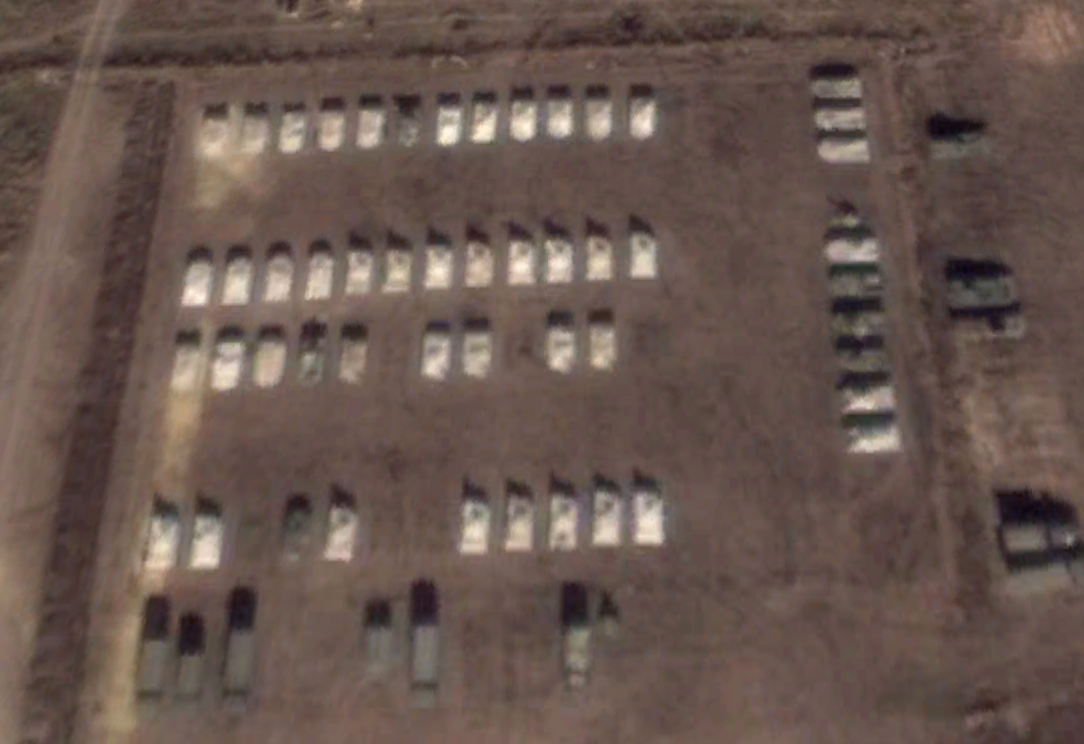
Analyzing the military hardware inside the Russian invasion base in Russia’s Rostov region, there was one thing that puzzled me for several days. Between the different battle groups were a number of white spots, which I found hard to identify for quite some time (picture below, exact position on a map).

winter

First, I thought those were tents as they have the same color as them of them inside the base, but a second look confirmed, those are army vehicles. After several discussions with other analysts, we still had no real clue. Neither the idea that those were the “aid convoy” trucks nor “MC – Russian peacekeeping” vehicles was quite convincing. The aid trucks enter Ukraine officially and don’t have to “hide” at such – formerly semi-secret – base and Russia – after some public mulling – decided to not play the MC (“peacekeeping”) card in Ukraine. Then finally, the bitter truth filtered through.

After @DajeyPetros spot and my analysis of the Russian invasion base, I read an article by the AAAS, confirming the base was established around March 2014 – a date, I could not confirm as I just knew, it was developed after October 2013. At this time – 5 months before the Russian army invasion in Eastern Ukraine in late August – thousands of troops and hundreds of weapon systems were prepared to be deployed inside the neighboring country – all according to a much larger plan and while the world looked at Crimea.

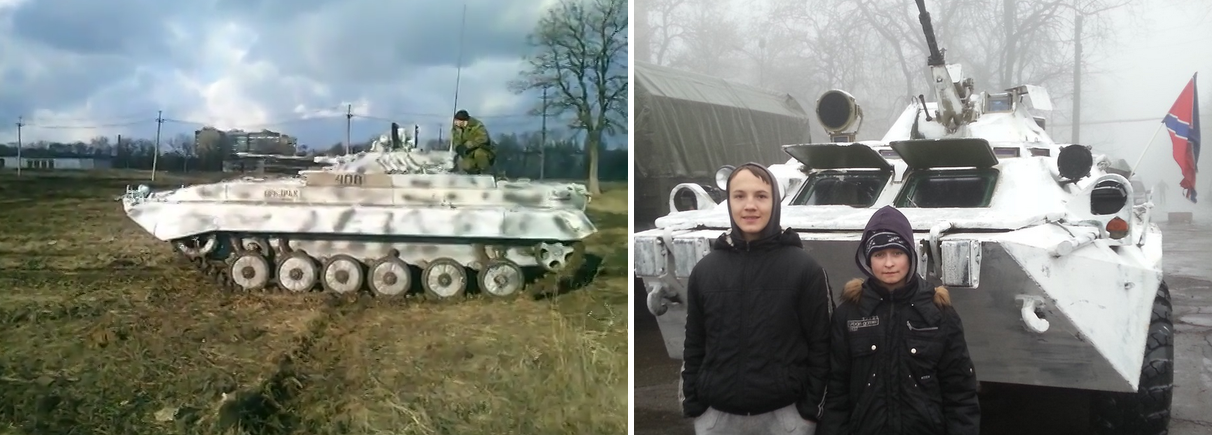
So for what could these white vehicles – 90% sure BMP and BTR  – be positioned there in October (the date of the satellite image) or even earlier?! … WINTER WAR!

And guess, what showed up shortly after – far too earlier, because long before prepared and not prepared for a late-starting winter – in Luhansk and Donetsk regions?! Correct. White-colored BTR and BMP. Moscow planned its escalating – or at least at no point cutting back – winter offensive inside Ukraine far in advance, probably just after the August offensive, in any case well before October 2014

bmp

left: BMP-2 in Donetsk, right: BTR-80 in Luhansk

What does all this tell us? What we see is sufficient evidence that Russia never had the plan to halt aggressive operations in eastern Ukraine – especially not this winter, which will probably hold for the next 2 months in Donbas. Its offensive capacities in manpower and equipment were very openly built up during the last 3 months all across the occupied territory and the base satellite images reveal that it planned what it did in March for August and in October for January – now. What we see in eastern Ukraine is nothing like “sudden” or “unexpected” developments, but an escalation of warfare and offensive operations within the plot of a master plan. It is going all according to Kremlin’s plan, developed long ago and – at least 50% – announced to Ukraine and the world since October 2014 at latest. Saying, we are “surprised” now shows either very limited foresight or dishonestly to itself and its people.

Making sense of the latest Russian offensives in eastern Ukraine

This morning, the Ukrainian army reported that the number of Russian invasion forces attacks “over the last day” stood at 50 in total. Such a figure was not reached since the Minsk agreement took effect in early September last year. 4 Ukrainian soldiers were killed during these 24 hours, and another 8 injured. At the same time, 2 civilians were killed and 8 injured in Donetsk city due to shelling over the same period of time, according to the city administration.

While over the last 4 months of the Minsk “ceasefire” and the Ukrainian-called in “silence mode” from December 9, the number of daily Russian attacks never fell below 5 and in average stood at 10-20 per day, 50 is a new peak and the final proof that the current appeasement policy by the Ukrainian government, namely the September 5 and 19 “truce” and the December 9 “silence mode”, are not working. However beyond that doubtless admission, the question arises, what the strategical aim of these attacks could be and why Russia is willing to turn up the heat again despite the fact, its territorial gains inside Ukraine are not challenged and it could consider itself satisfied with the strip of land, it has brought under its control so far.

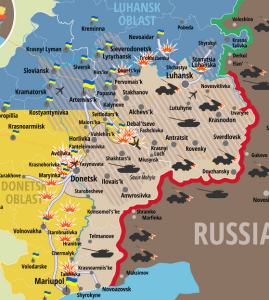
A – meanwhile – good indicator for the daily spatial allocation of the Russian aggression is the situation map, published with daily updates by the Ukrainian defense ministry. After months of showing a far too “optimistic” picture, it is now quite accurately filled with most recent information and, despite missing some attacks, a good foundation for a more detailed analysis.

This is today’s map:
map_8.1.

ATO map, showling the situation in the Donbas between January 8 and 9

At a first glance, the large number of “locations of combat” – indicated by the small orange explosions – along the front strikes the eye. While an exact count of those little “blast” symbols is not possible, it is fair to say, that their number is well below 50, showing the difficulty that comes with such sources. However what can be seen is that those symbols indicating fighting are ranged along the border between the Russian-held and the “liberated” Ukrainian territory with some dots being further inland, signaling long distance weapons fire.

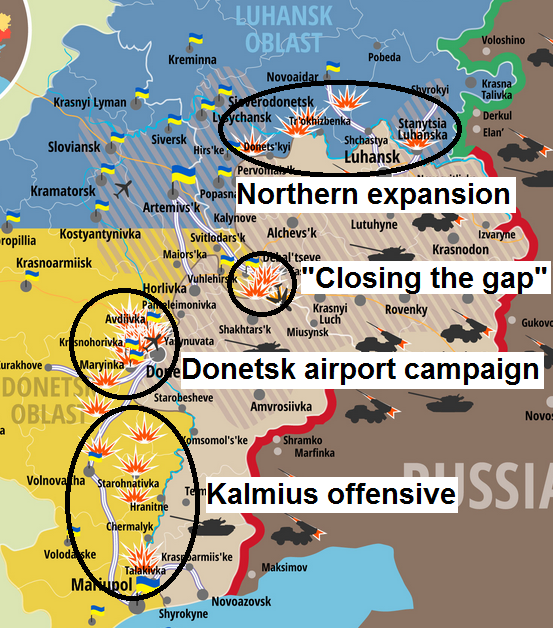
The following map is an – informed – strategic assessment of those “locations of combat” (also known as “Russian assault target areas”), dividing the entire territory into four combat zones. Doing this, it becomes possible to make sense of these dozens of attacks, assigning them to possible mid- and long term in strategic goals of the Russian invasion army. What becomes visible are four main theaters starting with the “Kalmius offensive” in the south, the “Donetsk airport campaign” in the west, operation “Closing the gap” in the center and the “Northern expansion” in the north. These four offensives will be discussed in the following paragraphs, trying to understand what could be Russia’s purpose by leading them.
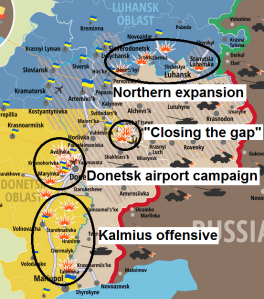
Map

ATO zone, devided into Russian campaigns, January 8-9

The Kalmius offensive

After invading southern Donetsk region in late summer last year, Russian forces quickly advanced via Novoazovask and Telmanove towards the west. Not the Ukrainian army, but a natural barrier, the river Kalmius slowed down their advance, giving retreating Ukrainian security forces the time they needed to build a line of defense -behind the river. Between September an December 2014, Russian forces mainly attacked the towns and villages east and north east of Mariupol, but only very rarely the wide strip of land between the coastal town and Starobasheve.


kalmius

The Kalmius river attack area

This changed on January 3rd, when Russian invasion forces started using heavy weapons like artillery, tanks and multi launch rocket systems to launch attacks on several towns right along the river as well as Ukr-held towns and villages behind it, serving as resupply bases or simply resting areas for Ukrainian troops – and homes to thousands of civilians. These attacks intensified over the last week, expanding not only to indirect fire, but also to actual crossings of the river and attemps to flank Ukrainian troops, taking Hranitne, one of the few towns with a bridge across the Kalmius. Several Russian troops were killed during these attempts. Nonetheless, during the last 2 days, this offensive was even intensified with a double-digit number of attacks between January 8 and 9.


Attacking the Kalmius river (Minsk demarcation line) on the entire front bears several strategic advantages for an invasion army, not feeling bound to any signed treaties. During August and September 2014, it attempted to directly attack Mariupol, which didn’t work due to a strong buildup in Ukrainian army and National Guard troops. Later, they tried to bypass the city with the aim to encircle it, some 5-10 km north. This also miscarried. By broadening the active front line by around 60 km, Ukrainian defenders are forced to stretch thin, trying to halt any possible crossing of the river along the sparsely inhabited riverside. This is of particular importance as we are in the middle of winter and the river may freeze, allowing troops and vehicles to cross it without the need of a bridge. The riverside was until a few days ago only guarded by scattered Regiment Azov National Guard troops, being equipped with mostly light vehicles like jeeps and small arms with a few heavier weapons like T-64 tanks or ATGM to defend against attacking armored vehicles. Furthermore, the Kalmius river frontline is one of the closest to the Russian border and the main invasion hub, making it easy to resupply advancing forces from inside Russia. If Russian forces manage to push back Ukrainian defenders at only one sector of the river front, they will be able to establish bridgeheads on the left side of it, being able to directly attack cities like Mariupol or Volnovakha, which might be the final aim in this region.


The Donetsk airport campaign

It is no secret that Russian forces seek to entirely control Donetks airport which must feel like a sting in their meat, being a – hypothetical – direct port for attacks on the DNR’s wannabe capital Donetsk. Thus, this front was always one of the most active, also and especially during the almost 4 months of the Minsk ceasefire farce. Until December 9, Ukrainian forces defended like lions, firing back with all kinds of weapons at Russian attackers and killing up to 500 of them within a few weeks (maybe even more between late August and early December).
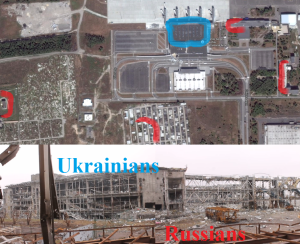
close Donetsk

However then president Poroshenko decided to forbid his forces returning fire “until their lives were in acute risk” and Russian forces established launching grounds for attacks all around – and not more than 50 meters from Terminal 1 and the Tower, which are today the only installations held by the so-called “Cyborgs”, the defenders of the area. Still, all attempts by the invader to directly attack the terminal complex were fought back with huge casualties on the Russian side. This fact plus the circumstance that attacking forces are now too close to the target to use heavy weapons against it led to a final change of mind pincer movewith the attackers, deciding during the last 7 days not to cut the airport from the Ukrainian-held territory anymore but the territory from the airport, encircling it in a wide curve, forcing – then – besieged forces to surrender as for the lack of food and ammunition. Similar tactics were used successfully in Saur Mohyla and Ilovaisk in late August last year. On January 5, the Ukrainian intelligence service voiced exactly that concern, namely that a pincer movement by Russian invasion forces from Spartak and Donetsk’s Kuibyshivs’kyi district is in the planning and would have the price of the entire airport.
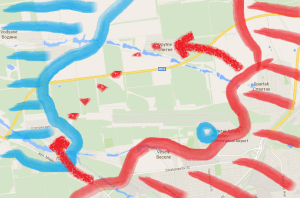
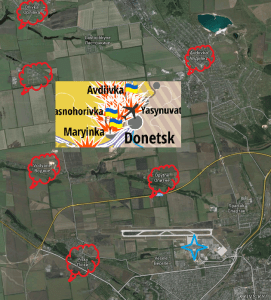
northern donetskSuch move has to be prepared, taking into account that strong Ukrainian army formations are positioned all to the north, north west and west of the airport. So Russian army artillery and missile troops started shelling not some but literally all Ukrainian held towns and villages in the three cardinal directions of the airport. As the ATO map is not able to show such concentration of fire in a meaningful way, I developed a map with the exact targets according to the Ukrainian army reports.

Thanks to the RT cam, live footage of the shelling can be seen and heard day and night, week for week, month for month. After realizing that a direct assault would be impossible and the Ukrainian-given period of time to gain strength, Russian forces seem now self-confident enough to prepare for a much wider offensive, not only trying to invade the airport, but all the Ukrainian-held front line towns around it.


Operation “Closing the gap”
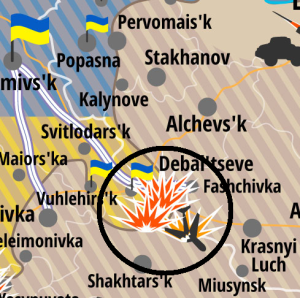
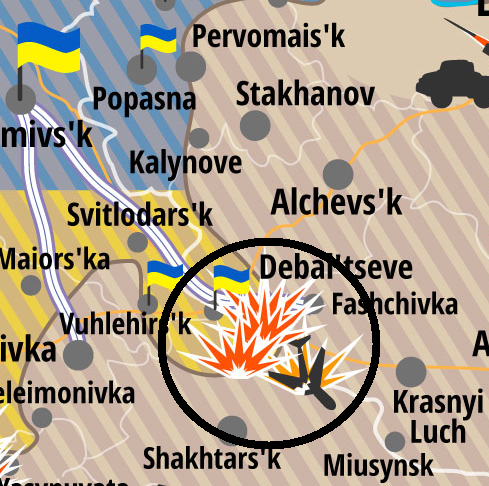
debaltseveThe Ukrainian-held area leading to the important railway knot city of Debaltseve not only looks like a cut into the “self- or rather: Moscow-declared people’s republics of Luhansk and Donetsk”, it also feels like one for the both regimes and their Russian masters. At the same time, it is an obstacle in logistical terms for invasion forces, wishing to move freely between Luhansk and Donetsk city. Thus, it is a declared goal by the Russian occupation command to close that gap, if not by negotiations (as was hoped for in mid September), then by force. This target was never given up during the “ceasefire” and there was not one day without attacks on front line villages like Nikishyne. However rare footage from the area (by Graham Phillips) showed some rather poorly-equipped Russian and pro-Russian infantry troops, not being able for major offensive operations in October and November. Now, Russian forces use large caliber weapon systems like Grad missiles and even tanks, especially over the last 48 hours. This indicates, they move from “provoking” Ukrainian forces holding that front to rather serious offensive operations, possibly resulting in territorial gains and the ability to directly attack Debaltseve itself.


Northern expansion
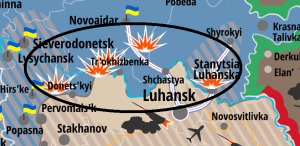
northern luhanskLast but not least, Luhansk region remains another hot spot of Russian invasion ambitions. During the first months of the “ceasefire”, the area along the Bakhmutka highway (M04), leading from occupied Luhansk to liberated Lisiciansk was one of the most active zones of confrontation. “Russian Cossack” terrorist troops felt – seemingly against all agreements as they received multiple heavy weapons to invade Ukraine – not bound to any orders from Moscow anymore and attacked at will, capturing “Checkpoint 32” and Smile in late October, taking more than 100 km² of Ukraine. However after this, troubles grew between those forces and the Moscow-loyal “LC (Luhansk Poeple’s Republic)” regime, resulting in battles against each other and a lull in fighting the Ukrainian army. Ultimately the most rebellious Russian commanders were either killed (January 2) or forced to return to their homeland (January 5) and the Russian army took control of all fighting forces in the area. Since then, the front is even more active and dangerous with a Russian invasion army, willing to recapture the earlier-lost territories around Severodonetsk and Rubizhne in the north west as well as Stanitsa Luhanska in the east. Especially this area would Russia give more kilometers of direct border line between its mainland and the invaded territories inside Ukraine, being a win-win situation in its perspective.


In conclusion it is simply a fact that shortly after the observed and confirmed reports of rotation and replacement of former paid mercenary forces with regular Russian army troops all across the occupied territories of Donbas, attacks on Ukrainian positions and towns as well as their deadliness have sharply increased. After those 50 attacks being shown in the map used for this analysis which took place between January 8 and 9, the following 12 hours brought another 24 attacks on Ukrainian forces, indicating that there won’t be any let up in the near future.

Russia definitely has once again turned up the heat and increases its efforts to control even larger parts of Ukraine, willing to conquer those in a brutal and way which is against international law and against all its promises to at least calm down the situation or even better withdraw its forces from Ukraine.

On the Ukrainian side – and I know, this sounds like a broken record, actions must be taken now to spoil Russia’s appetite for more Ukrainian land by letting them pay for every square meter they attack as much as possible. This might be the only way to lead it to a major decision: “Blink” once again like in the end of August and being punished with more international sanctions .. or finally come to its senses and stop its obvious efforts to illegally capture more soil of its western neighbor.
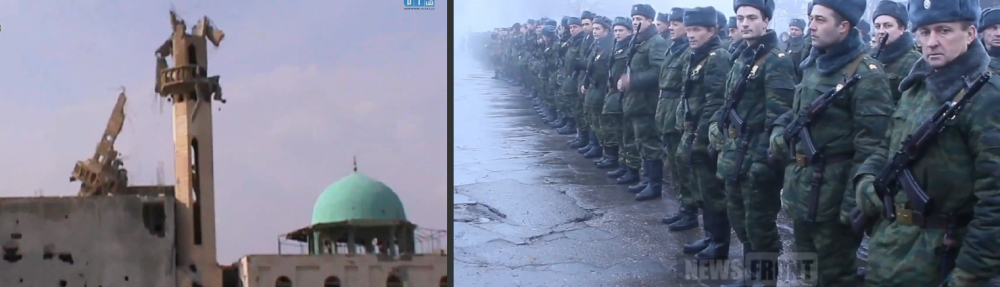
One base to rule them all – five facts you should know about Russia’s main invasion hub

On January 6, spotted that the latest updated Google Earth satellite images revealed / included the base, many people knew about, but nobody could ever locate due to Russian army security measure to not leak meaningful footage of it and the lack of recent satellite footage from the area.

The Russian invasion, that started in April 2014 and continues to that very day includes hundreds of tanks, apcs, MLRS and other vehicles as well as thousands of shells, missiles and last but not least tens of thousands of Russian army personal as well as Russian army-trained “volunteers” or rather paid mercenaries / invasion troops. Such invasion can not be planned and organized from Moscow alone or via regular army bases, which are either too far away from the Ukrainian border or by far not large enough to handle the logistics necessary for such an operation. It needs (at least) one major logistical military hub. This hub was revealed by the latest Google Earth satellite image update.

The following article answers 5 questions, you should know about when talking about that base in particular and the sophistication and organized malice of the Russian policy towards Ukraine in general.


1. Where is the base?

The base is located in a strategically brilliant position. 23 km north east of Taganrog and 30 km north west of Rostov-on-Don, it is in close range of several major Russian army hubs, including military bases, airports but also civilian supply structures for the daily life of the thousands of troops inside the base.

rostov taganrog

Strategic position in Russia

However, the major significance of the localization of the base appears, when we look at it in relation to the deployment zone in Ukraine. From the very south to the very north of the today mostly-occupied areas in Donbas, namely the centers of Mariupol, Donetsk and Luhansk, the distance is almost exactly 130 km, meaning an offensive- as well as quick reaction potential at all sectors of the front within the same period of time. At the same time, the base if 48km from the nearest Ukrainian border point, giving it a “safety distance” to possible counter attacks.

ukraine-base

Strategic position in relation to Ukraine — map source: Ukr. ATO


2. How large is the base?

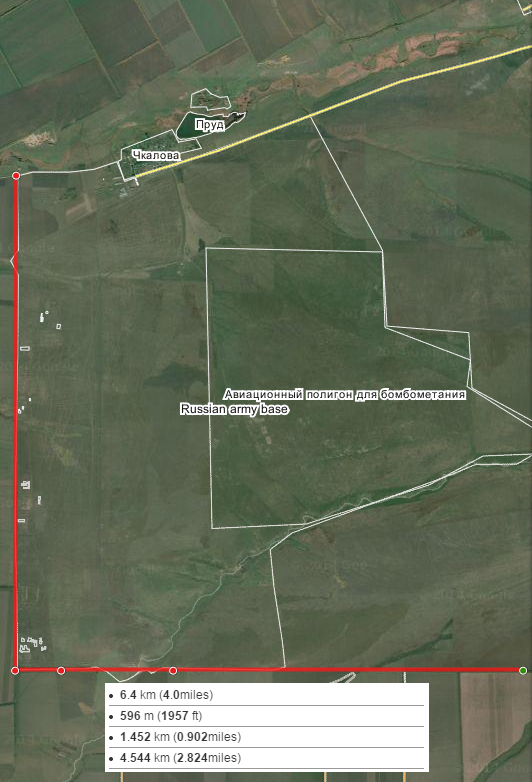
It is HUGE … The north-south expansion of the base is exactly 6.5 kilometers, so 4 miles. There are several concentrations of buildings, tents and vehicles all along that axis. The east-west expansion depends on what you regard as being a “military base”. In a width of 600 meters, we have the hard infrastructure of the base, again including buildings and vehicles plus positioned artillery pieces and much more (for more, read 4.). In a width of 2 kilometers, we can see extensive tracks, probably from intense training exercises and scattered current and former structures, which were used as forward positions and observation points. In its total width of 6.5 km, there are multiple craters visible, likely from artillery and tank shelling.

So in conclusion, we have a built up infrastructure area of 4 km², a vehicle training ground of 10 km² and a firing range of another 30 km². Adding all this to a coherent military installation, we find an area of some 40 km² which as an example is 4 times bigger than the airport of London Heathrow.

base perimeters

Dimensions of the base


3. When was the base established?

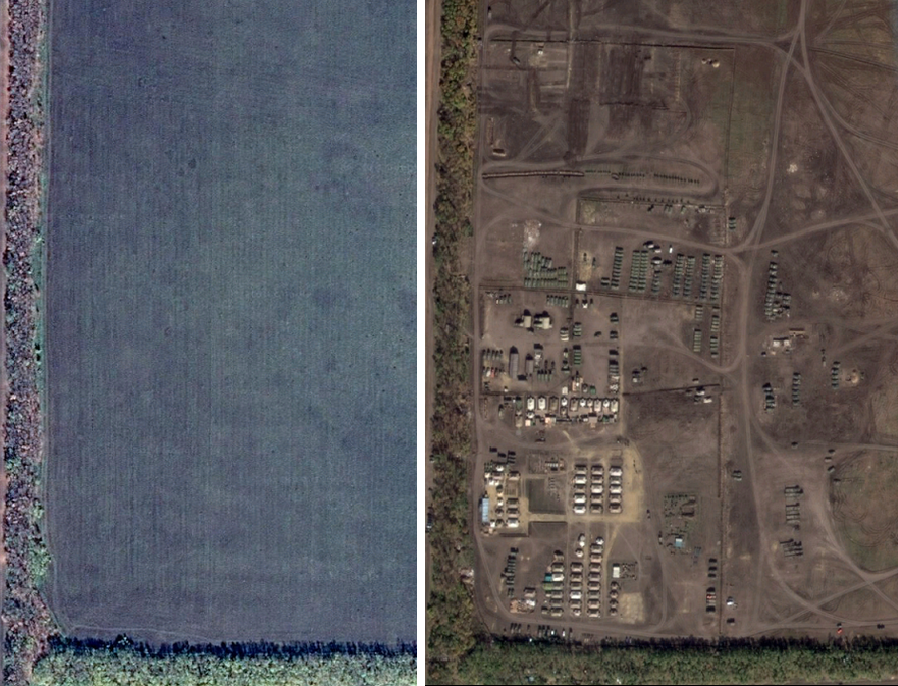
The area in question was last scanned by available satellites in October 2013, so 4 months before the Russian invasion of Crimea started and half a year, before Donbas was for the first time attacked and occupied by Russian forces. At images from that time, nothing is to see that would indicate the soon emergence of a large military complex or only a new road or farm on the concerned field. One year later, a complex military installation exists at this large field. So given the fact, it would need at least 1-2 months to build the entire infrastructure (including fixed buildings), the date of the base formation could be in August 2014.

2013-2014

Comparison Left: October 2013; Right: October 2014

But there are hints, indicating an even earlier start of construction and use. Between the developed parts of the base, large areas with former formations can be seen. What happened to the units in these areas? They were either given up, moved to another – the current – October 2014 location OR – which is the most likely version – were completely deployed as invasion army battle groups to Ukraine. Three examples are given below. Again: Remember that all these major installations were built up and removed between October 2013 and October 2014.

old fields

former battle group positions inside the base

Taking into account that it took also 1-2 months to build these developments and another few weeks to remove them once again, it must be concluded that the base was built up and used at least since June 2014, possibly even earlier. This would mean that all escalation, especially the one from late August, costing over 1000 Ukrainian troops their lives, was planned long before, showing that Russia had plans for a major escalation even before the Ukrainian army moved into the mostly unarmed separatist-held cities in early summer last year. It also shows that after annexing Crimea, Russia never planned to rethink its policies and lied all along, claiming it was finished with its expansionism inside Ukraine.


4. Which military hardware is inside the base?

In brief: All it needs to lead a war and all, we saw and see entering Ukraine from Russia.

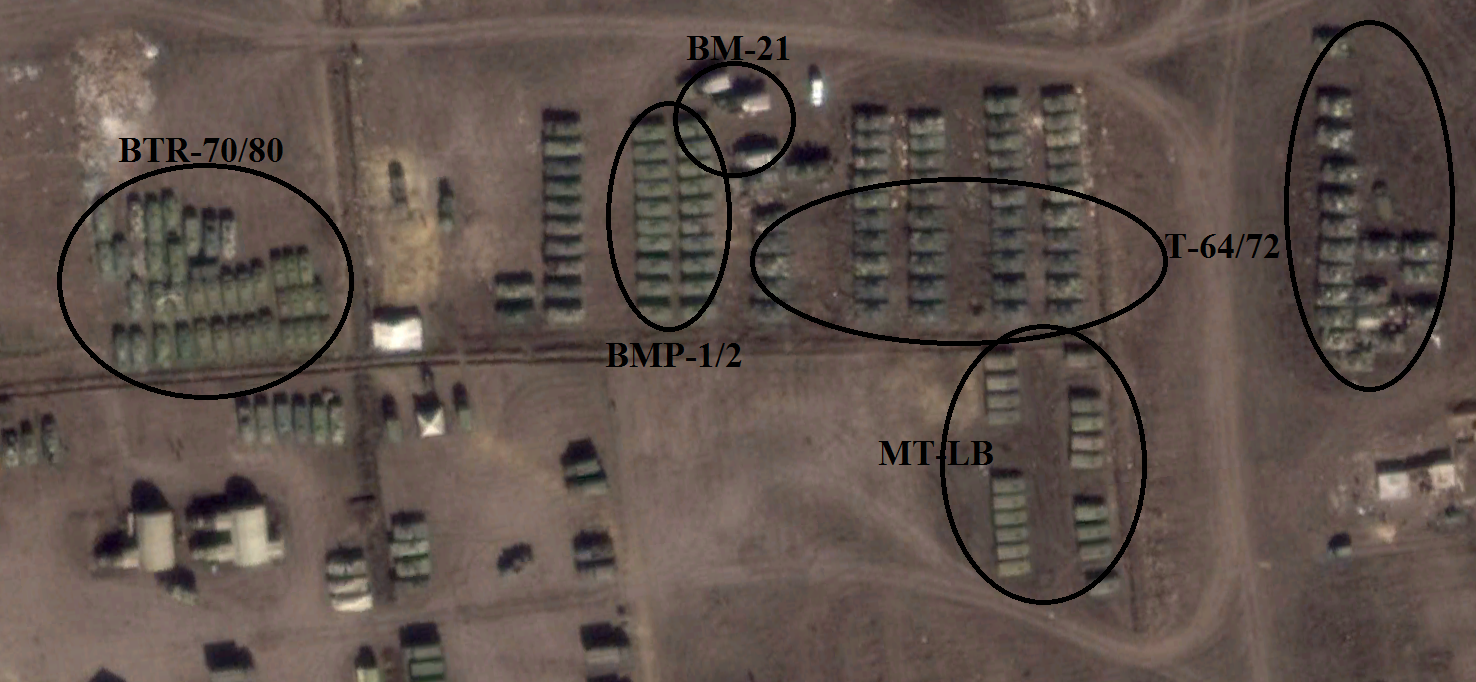
There are several concentrations of Russian army vehicles of the same type all across the outlined base parameters. However, we are talking about commercially detailed satellite images, so there is it is possible for experts to identify the general model of a weapon system, but not to distinguish between different versions of it (like BTR-70 or BTR-80). Nonetheless, I have identified groups of KamAZ and Ural trucks, BMP-1/ BMP-2, BTR-70/BTR-80, MT-LB, MT-LBu, Msta-S and Msta-B, BM-21/27/30 and last but not least T-64/T-72. The following image is only one example of one battle group, being stationed at the base.

vehicles

Weapon systems

The next image seems extremely interesting as it shows several multy launch rocket systems, but also something, which looks like sophisticated air defense systems, possibly the SA-10 “Grumble”. However, this can not be said for sure as we are talking about satellite images with a maximum resolution of maybe 1 meter large objects.

bm-21

MLRS plus AA systems?!

Summarizing the vehicles and weapons systems at the front it can – once again – be excluded – that this is any kind of regular or defensive military installation. It houses – as I said before – battle groups, ready to be deployed as punchy forces in a neighboring country, leading to the last question.


5. What is the main purpose of the base?

While such question could (or even should) not be answered out of the blue, the first four points of this analytic article qualified it for an informed answer. Looking at the position, size, age and equipment of the base, only one conclusion is possible: This is the one base to rule them all. It was established and still is operated for one reason: To keep the invasion and ongoing occupation of neighboring Ukraine running.

Its current and former visiting forces suggest the assumption that it is BOTH a RF armed forces-led training ground for “voluntary”–> paid Russian invasion forces and the small number of real Ukrainian separatists where they can learn / refresh their driving and firing skills before going to war AND a “traditional” Russian army base, serving as a bridgehead for all major offensive operations and a backup- and retreat area for resupplies and reinforcements. Just today, the Ukrainian defense minister said that 7.500 Russian army troops are serving in Ukraine at the moment, being constantly rotated with their entire equipment. Now we know to / from where and that fresh battle groups are always waiting to be deployed.

All in all, the – at some point inevitable – revelation of this large key base is another reminder that Russia is not hiding its efforts in its war on Ukraine anymore and probably never did. It is also a reminder that the mainstream media and most Western – and Ukrainian! – politicians are painting an entirely wrong picture of the situation. We are not facing a “covert war”, nor have there ever been “Russian-backed rebels” in Ukraine. What we see since almost 11 months is an aggressive war by the Russian Federation vs. the sovereign state of Ukraine, with all organisation and logistics such war necessarily needs.


Did you have a good read? Please support it with 1$ per month or more!

Covering the war in Syria – thoughts on the latest snowfall

Even for an observer, covering the war in Syria for the fourth winter now, it was an odd, new and strangely also beautiful thing to see what a layer of thick, wet snow brought to the south of the country today.

Despite reports of the first refugees in- and outside Syria freezing to death due to the unusually cold weather in the region, fighting at all fronts from Daraa up to the capital region Rif Dimashq  came to a sudden halt today as for the same reason.

The town of Inkhil, – “Angel” in English – which saw hundreds of Assad air force raids and thousands of deaths caused by them looked peaceful in dense snowfall today, as did other cities like usually embattled Shayk Maskin.

inkhil

Inkhil

Also in the Damascus area of Jobar, which is one of the hardest and most destructive battles in southern Syria, raging at the same place for 40 months now, no air raids and only very few artillery strikes and direct encounters were reported today. Syrian rebels – no. no “islamist extremists, but people, defending their homes against the murderous Assad regime – used the unexpected lull for a little snowball fight, enjoying the short period of relaxation.

jobar

Jobar

And last but not least, children – the most innocent victims of the war in Syria, entering its 5th year now – used the “white miracle” for some fun or at least distraction, however under different preconditions… The upper part of the picture shows children playing in the snow with their parents in the Assad regime-held part of Damascus. Children which seem for some reason – sectarian belonging, allegiance of their parents or just the geographic location of their homes – more worthy to live for the dictator than other.

The lower part of the picture shows children living 5 km north east of Damascus in the suburb Duma. For the same reasons as called above, those children are not worth living for the Syrian dictator, forcing them to live in shelters and having lost most of their relatives and friends during the last four and a half years.

kids

Damascus and Duma

Worlds apart, some living in relative calm and security, others in the middle of the horrors of Assad’s war, a look into the faces of ALL of these children shows their happiness with the situation in that very moment, no matter what.

Realizing this, every human person must see the senselessness and absurdity of this war and armed conflict affecting innocents in general. Children are children, not more or less worthy lives, just because of their ethnicity, belief or the political alignment of their parents. It is simple as that. Every emphatic person should understand that and every government believing in children –> human rights, should do everything in its power to protect children from a regime or entity that decides about life or death by such distinctions.

Coming back to the initial situation of this little as optimistic as possible article on Syria it remains to say that it is a good feeling that – even in Syria – at least the weather in general and snowfall in particular do not distinguish between humans and – at least for a short period of time – brought peace to some of the most affected of the war in Syria.

However snowfall will end and after that, it is once again up to the global community to stop that war by all available means.

The Russian invasion continues – latest military developments in Ukraine

Today on the 4th of January 2015, we are 27 days into the Ukrainian government’s latest initiative of the “silent mode” – the latest additional appeasement measure after the “Minsk agreement” from September last year. Still, there is no visible let up in Russian attacks on the front line all across occupied Donbas, reaching from southern Mariupol until Stanitsia Luhanska on the north eastern end of the new de facto border between Russia and Ukraine. The number of daily Russian attacks on Ukrainian held towns and military positions slightly decreased from approximately 40-50 a day to now 20-30, however this is rather due to the fact that Russian forces now decide when and where to hit, being able to concentrate their forces on the target areas, not being afraid anymore of Ukrainian counterattacks or even return fire after their assaults. Just during the first 4 days of 2015, Ukraine saw 2 civilians and 1 soldier killed in fighting, while at least 7 civilians and 12 more Ukrainian troops were injured. Hot spots of the fighting remain the same as before December 9, meaning the Bakhmutka highway in northern Luhansk province with its Ukrainian strongholds Krymske, Zolote and Hirske being targeted daily, the town of Stanitsia Luhanska on the (old) Ukrainian-Russian border and Popasna, opposite Pervomaisk. Yes, the number of Grad missile attacks decreased, but more direct artillery, mortar and small arms encounters remain a daily appearance with civilians as well as Ukrainian armed forces casualties. In Donetsk region, the airport of Donetsk city as well as its bridgeheads in Pisky, Opytne and partly Avdeevka are subject to daily shelling and fire attacks, while it remains unclear, if Terminal 1 of Donetsk airport is still accessible via Ukrainian.held territory or the two allowed resupply routes via Russian-held territory signal an even worse situation. It is chilling that Ukrainian troops at the airport – the so called “Cyborgs” – claim, they were not rotated and resupplied with arms and ammunition since more than 8 weeks.

Rus flags

Picture shows flags of “Novorossiya” on top of Terminal 2, only meters away from Terminal 1, held by the Ukrainian army

A rather new development in terms of Russian attack focus areas stretches along the Kalmius river, north of Mariupol. This river is the official demarcation line, agreed on by all parties in the Minsk memorandum. However, as we know Russian forces and their local proxies do not accept their own signatures under the paper, it is not astonishing they are willing to extend their area of control beyond that natural border. Thus, attacks started on January 1st with all sorts of weapons, even face to face encounters, trying to push back Ukrainian forces – mainly from the Regiment Azov national guard – and build bridgeheads on the left side of the river. Between January 2 and 4, Orlivske, Hnutove and Hranitne came under attack from Russian forces.

Kalmius

Map shows locations and used weapons, acc. to the Ukrainian defenders

Beyond concrete attacks on the Ukrainian line of defense, multiple other worrying developments were recorded, mainly a – partly violent – replacement of Russian “volunteer” (former army) mercenaries with more Moscow-loyal forces, accepting the high command from the Kremlin and behaving less “wild” on Ukrainian ground. Despite only little facts available, it seems those Russian invaders, trying to build a “New Russia” – “Novorossiya” – are fought and replaced by the more “legitimate” pro-Moscow regimes, namely the “People’s Republics of Donetsk and Luhansk”. While one Russian ringleader, called “Batman”, was killed by LC regime forces, others of his group swore to fight both, the local regimes as well as the Ukrainian army from now on. Ukrainian reports say up to 23 militants from both sides were killed in recent infighting, seemingly supported by aftermath pictures.

batman

Aftermath of LC-Novorossiya infighting in Luhansk region

While those, not behaving like Moscow wants it, are sent back to Russia or – if not willing to – obliterated without mercy, those, who obey to the Kremlin leaders’ will are rewarded with the latest Russian army military hardware, namely the BPM-97 “Vystrel”. Those apc, only produced in Russia and only used by Russian border troops, are the latest hint that the very leadership of the Russian Federation has nothing in mind that could equal any kind of retraction from its offensive position in Ukraine.

BPM-97

The BPM-97 in “war games” in Luhansk province

At the same time, it becomes once more explicit that Russia – just like with its T-72B1 or T-72B3 – would never give its latest armored personal carriers to any “rebel” faction in some renegade region abroad, but would only allow a free “export” of its 2000s hardware with qualified and loyal – Russian Army – personal. That this personal is active as never before in Ukraine can on the one hand be recognized by multiple reports:  Even the Ukrainian NSDC, which has a long history of downplaying Russian involvement in the conflict, fearing a cut off from international funds, said on January 3 that hundreds of Russian Federation troops entered Ukraine lately. Other reports from local witnesses and media reported for instance that 300 Russian soldiers had taken over Horlivka at the frontline with Ukraine, sending “DNR” forces to the hinterland. On the other hand, more and more evidence turns up that Russian soldiers from the Far East, seen approaching from Ulan Ude and elsewhere in November, are now fighting in Donbas, like in Horlivka as mentioned above.

horlivka

Far East Russian soldier in Horlivka on January 1

Last but not least, the Russian army (ab)used the Ukrainian “silence mode” to build up a working military logistic and infrastructure network in Donbas, now being able to (at least for a while) repulse any kind of military attack from the Ukrainian mainland. Part of this network are air defense systems and backup bases in Donbas hinterland (10km or more from the front line), like this base with dozens of BMP-1 in a former public transport depot, recently recovered and geolocated by me in Krasnyi-Luch.

krasnyi-luch

Russian base in Krasnyi Luch

In conclusion, there is no indication at all of Russia or its two local puppet regimes, having any intention to stick to the signed Minsk agreement. Hence, there is no sign on the horizon that the Ukrainian president’s peace plan, ceasefire or “silent mode” were anything close to be working in Ukraine’s favor. Therefor it is up to the Ukrainian government to chose if it wants to further stand idle and watch how a powerful Russian invasion force is taking shape on Ukrainian soil, able to hit hard when it where it chooses — OR if it wants to regain the initiative in the conflict by not allowing militants to strike at will and unpunished, killing Ukrainian citizens and soldiers and – slowly but steadily – expanding their controlled territory inside Ukraine and further shrinking a young, but proud and – if willing – also punchy European nation. Did you have a good read?! Please support my work with 1$ per month or more!